Beijing needs crash course from S.Korea in soft power PSY-chology
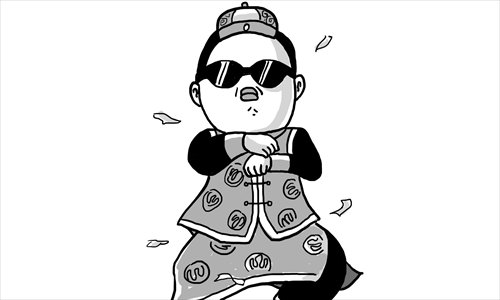
Having swept around the world, South Korean rapper PSY's "horse dance" caused a sensation in China over the past few months.
The dance has been adapted for school gym exercises in some cities, diverse pastiches have been seen on many shows and PSY's dance moves can even be seen performed by old people during morning exercises.
PSY is now reportedly gearing up to appear on CCTV's Spring Festival gala, which has sparked some debate.
This time, criticisms outnumbered praise.
Some criticized the ugly and inelegant gestures of the dance as being unsuitable for the gala, others were irritated by the allegedly high appearance fee being paid to PSY, as it was reported that several TV stations were competing for PSY's debut. A few voices even sought to disparage South Korean culture.
Most of these reactions are understandable. It reflects the logic of public opinion set by the interaction between China and South Korea.
PSY's success should be taken as a lesson. Chinese should analyze the reasons behind South Korea's ability to promote its soft power worldwide with an open mind.
This success is no accident. The South Korean government has long attached great importance to its cultural industry.
It has a long established cultural strategic development committee and has made long-term plans to allow its artists to thrive, with the purpose of promoting South Korean culture in Asia and in the world.
Recent years have also seen South Korea establish its Presidential Council on National Branding, further narrowing the gap between Korean culture and others.
These efforts have been the main reasons why Korean cultural waves have lapped at the shores of China, Asia and the world.
China has richer cultural resources than South Korea.
It has a greater national strength and larger international political influence.
But why does Chinese culture's international impact lag behind South Korea's?
And why can Chinese culture not create a brand effect as seen by South Korean pop songs and TV shows?
China should reflect on this and pay more attention to South Korea's strategic awareness on cultural development and its approaches to promote the industry.
A deeper reason for the popularity of PSY and his "horse dance" is that the dance caters to Western conceptions of Eastern humor and oddity.
Most Western fans of the song do not get its trenchant critique of Seoul's richer classes, but this is not a major problem.
Figuring out how to spread Chinese traditional culture and make it more acceptable and understandable to the world will require China to be more creative when developing its cultural industry.
We cannot blindly copy PSY, but we can learn from his success. From this perspective, Chinese audience should relax and enjoy PSY as part of the Spring Festival gala.
But bidding for PSY's debut at high prices is not necessary, as this will only spark public anger.
CCTV's Spring Festival gala is the most viewed program in the country. We welcome PSY's performance, as long as he doesn't ask for ridiculous fees.
He could simply be a friendly South Korea singer who can share in Chinese happiness on the eve of Spring Festival.
The author is director of Korean Study Center at Fudan University. opinion@globaltimes.com.cn