Big dreams
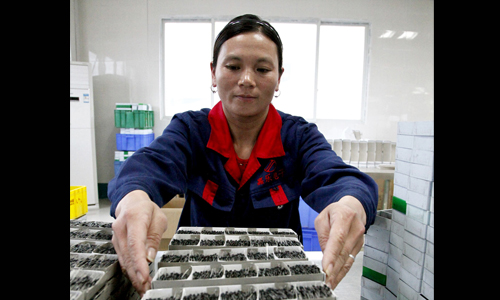
A female worker carries electronic parts at a company in Huaying, Southwest China's Sichuan Province. Photo: IC
Kong Xianming, a 49-year-old entrepreneur, felt both overjoyed and sad when an American client said he could not believe a cabinet from Kong's company had been made in China.
It was during the Spring Festival holidays in 2003 when Kong, general manager of Yichun Xincheng Furniture Co, received a call from an American client who told him he wanted Kong to be a long-term supplier.
"I felt proud but also sad. Why is it that China cannot make quality products?" Kong said.
Kong runs a furniture factory in Nancha, a small county with a population of 142,000 in Northeast China's Heilongjiang Province. Most ordinary people in the county have never seen a foreigner and younger people there often leave for bigger cities to earn more money.
After leaving a State-owned company, Kong set up his own furniture factory in 1994.
In 2003, an American buyer came to Nancha - which is known for its pine trees and wooden furniture - to look for a supplier for kitchen cabinet sets. Kong knew it was a big opportunity, but with only around 30 workers, Kong's small factory was not a leading candidate.
But Kong got the contract by responding fast to the client's demands and by shipping the first batch of his products without demanding a deposit in advance.
Focus on quality
Over the past 19 years, Kong has never spent an entire weekend at home.
"I always have a sense of urgency and am afraid of being left behind. So I only take a few days off during the Spring Festival because only at that time I know other people in the country are not working," he said.
Initially, Kong had no experience of dealing with foreign customers, no foreign currency account and little knowledge of trade rules.
But now he has long-term foreign customers and his company has its own technology, with independent intellectual property rights. Kong has been able to show that furniture made in China is not cheap and inferior, but can have unique design and modern technology.
The floor area of Kong's factory has expanded from an initial 1,000 square meters to 14,000 square meters. He still has between 30 and 50 workers, but the efficiency has improved thanks to advanced equipment and streamlined production.
"Even as a small company, we have a big Chinese dream. We want to develop our own products with independent intellectual property rights and build an international brand," Kong said.
"Our workers also have their own dreams. They want the best pay in the industry and for the products they make to be sold throughout the US," he said.
The concept of the Chinese dream was mentioned in November by Xi Jinping, the new general secretary of the Communist Party of China (CPC) Central Committee.
"Realizing the great renewal of the Chinese nation is the greatest dream for the Chinese nation in modern history," he said.
"The Chinese dream, after all, is the dream of the people. We must realize it by closely depending on the people," Xi was quoted by Xinhua as saying at the closing meeting of the first session of the 12th National People's Congress after he was elected president in March.
"For entrepreneurs at small and micro firms, their Chinese dream is simple and down-to-earth. They want to grow bigger, build a stronger brand, have easy access to loans and give better pay to their employees," Zhao Yongsheng, a visiting scholar with the Institute of European Studies at the Chinese Academy of Social Sciences, told the Global Times Thursday.
"But the harsh reality is that State-owned enterprises dominate most resources, and the dream will be no more than a mirage if the business environment continues to discriminate against small firms," Zhao said.
There are around 51 million small and micro-sized firms across China, but only about 10 million of them can get bank loans, according to China Banking Regulatory Commission.
On Sunday, Premier Li Keqiang called for more support for small and micro-sized firms during his visit to a small firm in Lanzhou, capital city of Northwest China's Gansu Province.
Medium, small and micro-sized firms are the major employers in China, Li said, noting that supporting them is vital to create jobs.
His call came after the State Council, the country's cabinet, unveiled detailed targets last week for supporting small and micro-sized firms. And in late July, it announced that value-added tax for companies with monthly sales revenue of less than 20,000 yuan ($3,258) would be scrapped.
New approach
Unlike Kong who is striving to get more foreign orders for his inland firm, Zheng Chen'ai, president of Wenzhou Aobenni Garment Co in East China's Zhejiang Province, is shifting his focus from foreign buyers to the domestic market.
"With sluggish external demand and appreciation of the yuan against the dollar, the international market is no longer our priority," Zheng said.
Founded in the early 1990s, Zheng's company once had a large number of foreign buyers. The company has around 600 workers and an annual output of 200,000 items of clothing.
"We cannot survive with the old model of simply relying on foreign orders. We need to restructure the model by reducing our scale, developing our own design and building our own brand," Zheng said.
Zheng said his workers were mostly born in the 1980s and 1990s and usually have a more affluent life compared with their parents.
"They want a better life, a modern working environment with advanced equipment. They want a laptop to chat online after work and want to go to bars to have drinks with friends. They want decent pay to support their leisure time," Zheng said. "Their dream is my dream and the company's dream."
"It's interesting to notice that the two firms set quite different business goals because they are in different geographical locations and at different stages of development," said Tian Yun, editor-in-chief of the China Macroeconomic Information Network website, run by China Society of Macroeconomics, a government think tank.
"It's also interesting to see that the firm in Heilongjiang Province is not following the old path of export-oriented firms in coastal cities by being a subcontractor, but rather it has its own intellectual property rights and design," Tian said.
"China is now at a turning point in its development, with the private sector expected to play a bigger role in reviving the economy. The plain and down-to-earth dreams of private entrepreneurs are the basis for China's future," he said.