‘Enigma of China’

Shanghai’s Pudong district Photo: IC
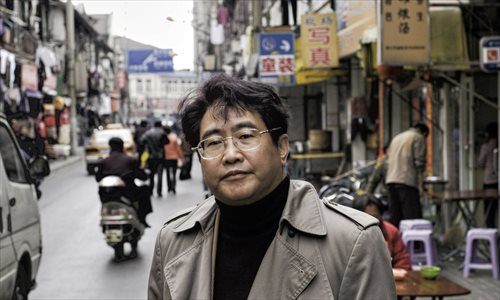
When Chinese President Xi Jinping met with US President Obama in June, former American ambassador Derek Shearer recommended two books for people to gain a contemporary understanding of China. Both books mentioned in Shearer's article published in the Huffington Post are from Qiu Xiaolong's eight-part Inspector Chen series. One was Don't Cry, Tai Lake, which is centered on a true case of industrial pollution, and the other, Enigma of China.
Add to that the new reading trend toward Japanese deductive-reasoning fiction and the highly rated investigative TV series, and you have a Chinese readership primed and ready for the return of a home-grown detective mystery writer.
Now working on his ninth book of the series, Qiu is the first ethnic Chinese to be selected as a finalist for the Edgar Awards. His work was widely read in Europe and North America, translated into French, German and other languages and winning high praise in many countries. In fact, foreign readers are more familiar with him than Chinese readers.
China in Qiu's eyes
Qiu went to America on a Ford Foundation grant in 1988 as a visiting scholar for translating poems by Thomas Eliot (1888-1965). After earning a doctorate in English at Washington University in St. Louis, Missouri in 1996, he stayed in America and worked for the university as a lecturer.
In that early period, he spent most of his time translating and composing poems. When he came back to China in 1997 after nine years abroad, he was shocked by the great changes of his hometown, Shanghai. The transformation inspired him to write down his feelings and thoughts about this country where he had lived for 30 years.
As poems are more likely to be used to express personal emotion but not that suitable for describing social reality, Qiu began to write fiction adapted from true stories. Qiu attempts to record the truth of society, including both the great development and the unveiled problems.
He researched some hotly discussed news events from his home in the US, then went back to Shanghai for several weeks, accumulating people's ordinary experiences.
"The distance makes me clear and objective," said Qiu.
Unable to publish articles in China for many years, Qiu chose to write directly in English. His first novel The Death of a Red Heroine was published in 2000, winning Best First Novel at the Anthony Awards in 2001 and entering the Edger Awards as a finalist.
Only a part of his novels have been translated into Chinese. When asked about why he does not write the Chinese version himself, Qiu expressed his dissatisfaction with Chinese publishers: "What I wrote in The Death of a Red Heroine actually took place in Shanghai, but they translated it as 'H city' which is really ironic."
He also said that the Chinese version omitted some chapters in order to maintain a good image of a model cadre. "As an author, the deletions and changes are quite heartbreaking for me."
Mystery of reality
Qiu's new book Enigma of China was published on June 18, 2013, as the eighth installment of the Inspector Chen series. He told the Global Times that he is now working on the ninth, which hopefully will debut at a book fair in France next year.
The series features chief inspector Chen Cao, who is well-educated and interested in literature while working as the head of the special-case squad, homicide division, Shanghai Police Bureau. He is smart and rational when investigating cases as a chief inspector, but is sensitive and emotional when composing poems.
Qiu said that the poet personality is a tag that makes him different from other famous detectives. The conflict between rational and sensitive sides makes inspector Chen a rounded character.
He admitted that he was influenced by traditional Chinese Gong An (criminal case) stories, such as The Celebrated Cases of Judge Dee, a series of detective stories written anonymously in the 18th century.
Most Western deductive-reasoning fictions are written in a plot-driven style so that readers can follow the detective and see what will happen next. In Qiu's mystery series, readers can find the murderer in the middle but the conflicts are focused on how they will be punished and whether the cases bring danger to Chen. In this way, the stories are classified more as character driven.
Most of the series are inspired by real-life corruption scandals, political intrigue and murders. Don't Cry, Tai Lake is based on the pollution of Taihu Lake exposed in 2007, and his latest in the series, Enigma of China, is based on the Zhou Jiugeng case - an official who was human-flesh searched by netizens for making improper comments about real-estate and was found wearing luxury watches, smoking very expensive cigarettes so that was exposed with corruption.
Qiu said that he was trying to depict these problems in Chinese society, and offer possible explanations of how these problems developed. He is trying to discover the truth behind these real incidents by making fictional characters explore the world.
Red dust in Shanghai
Gaining surprising success in the mystery genre, Qiu does not want to be limited as a detective novelist.
Qiu wrote another series of short stories that was serialized in Le Monde (published in Paris) in 2008. These short stories were compiled for the book Years of Red Dust in September, 2011.
The collection has nothing to do with the mystery series. Qiu explained that he prefers these selections over the inspector Chen series, and that he plans to continue with Years of Red Dust 2 and 3. He wanted to record every year with a short story beginning with 1949.
Qiu explained his fondness for the story collection this way: Before the air conditioner became so popular, most people in Shanghai sat outside their homes on the lane, telling stories and routine gossip that they heard from others.
Qiu believes that from this daily ordinary scene among neighbors, the real Shanghai can be understood.