‘Impressions of Love’
Stage work pays tribute to one of China’s greatest philosophical writers
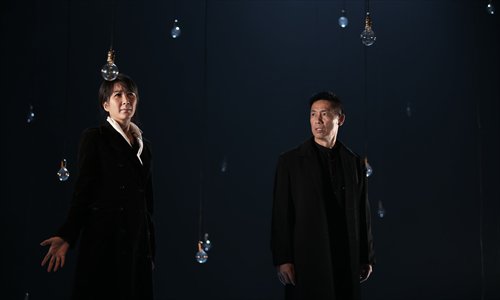
Xia Lixin (left) and Shi Liang in a scene from Impressions of Love Photo: Courtesy of Chen Lei
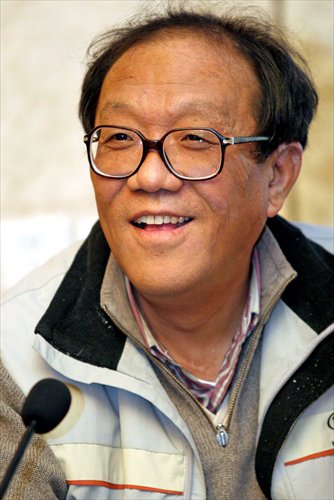
Late author Shi Tiesheng Photo: CFP
What is love? As an abstract idea, it may manifest a thousand different ways to a thousand different people. In the play Impressions of Love, the concept becomes a fragmented series of impressions. Sometimes clear, sometimes vague, sensible or sentimental, these impressions linger in one's mind eventually turning into one life-long sigh.
Adapted from late writer Shi Tiesheng (1951-2010)'s novel Retreat Notes, director Zhang Nan (Eurydice)'s Impressions of Love was staged from January 6-10 in Beijing in remembrance of the fourth anniversary of Shi's death. "For me, this was the best way to remember the author," Zhang told the Global Times.
Love and life
A deserted old house. A man and a woman meet and have a conversation about the past.
The play's story takes place in a place and time that could be anywhere or anytime. The main reason for this is because they're talking about eternal subjects: love and existence. Even the names of the four characters in the story are simplified to just four letters, O, F, N and Z, just as they appear in the novel, a move that helps emphasize the content of their dialogue even further.
O meets F in an old house that is about to be demolished. Sharing memories connected to the big house, they recall their respective lovers and share with each other their secret understanding of love and the impressions love has left on them through the years.
O, a female middle-aged teacher, is deeply disturbed by her feelings towards her husband Z, a painter who insists on only painting a white feather instead of her. She feels disappointed as a woman pursuing ideal love. F, a doctor, is still immersed in the pain of losing his first lover many years ago, when his family demanded he study in the former Soviet Union.
While O and F tell their side of things, a month later, N, a director and F's former lover, and Z, the painter, narrate the other side of the coin, revealing the death of O who committed suicide for unknown reasons.
Even though it is a play that depicts the characters' own memories and ideas about love, their conversations are really about life and death, existence and memory, which makes the stage work a journey exploring the essence of life itself.
An adaptation of Shi's novel, the play follows the book closely with most of the characters' lines read word for word. Considering the philosophical nature of the characters' conversations, although the play has more of a narrative than the book, it can still prove intellectually taxing.
Audiences may find that they not only have to stretch their imagination to come to grips with the story, but will also find themselves immersed in thought when they hear characters ask questions like, "Is there any other existence beyond reality?" So while the play is only an hour long, "such deep lines are a heavy meal for the audience to digest," Zhang said.
The drama - starring Xia Lixin and Shi Liang as the two female and male roles respectively - is actually a redirected version based on the Li Jianming version from 2011. "I redirected it as kind of a promise to Li. We agreed to put the focus on the impressions from the novel," Zhang revealed. "[In the new version] I cut some lines and highlighted the storyline more to make it more three dimensional."
Thinker and writer
Afflicted by a disease that left him paralyzed from the waist down when he was only 21, Shi went on to win many literature prizes including the Lu Xun Literature Prize with his large number of thought provoking novels and essays that explore the depths of life and the soul.
"Death is a thing that needs not hurry. Death is a festival that will fall inevitably," Shi wrote in Me and the Altar of Earth, the work that brought him nationwide fame. Since Shi's passing in 2010, fans of his works have held activities every year around December 31, the date of his death, to memorialize this writer who is regarded as China's most "philosophical" author.
Retreat Notes, Shi's semi-autobiographical first long novel depicts the social changes that occurred during and after the 1950s and how they influenced the fates of a generation of people like the characters of O, F and N.
"It is a philosophical work. Shi explores the way people see the world through the characters' stories, which is something I'm interested in," said Zhang, who is also a fan of Shi. "There are many characters and many entangled relationships, but as I understand things Shi wanted to show how we understand the world that is in front of us through subjective impressions."
"Though it's a bit fatalistic, I tried to depict an assuring attitude about the world throughout the play," Zhang explained. "Shi was an optimistic person. He had a deep understanding about pain in life, but he didn't respond with negativity. This work can lend us power."
Another important event paying respect to Shi was held on January 4, Shi's birthday, in Beijing. Attended by over 100 people including writers and Shi's friends, a number of Shi's works were read aloud at the party.
That same day, the Shengming Yangguang (Life Sunshine) Literature Society was established in memory of Shi's 64th birthday. According to one of the organizers behind the society, Shi had mentioned several times that he wanted to bring disabled writers in Beijing together to form a literature society.
Writer Cao Wenxuan, who also attended the founding of the society, expressed his love for Shi's works to the media that day, emphasizing Shi's literature achievements.
In Cao's opinion writing has become an essential part of Shi's continued existence and is the means by which he manages to delve into questions about life and communicate his understanding with others.
Despite the many difficulties in his life, Cao feels that Shi had "a praise and yearning for life. He dedicated himself to exploring questions about life and death, love and hatred, freedom and limitations, desire and morality, and so on. He's used his life to justify the flowering of life, and thus build our belief in ourselves."