China successfully completes low-altitude Long March-10 test, marking major breakthrough in China’s manned lunar exploration program
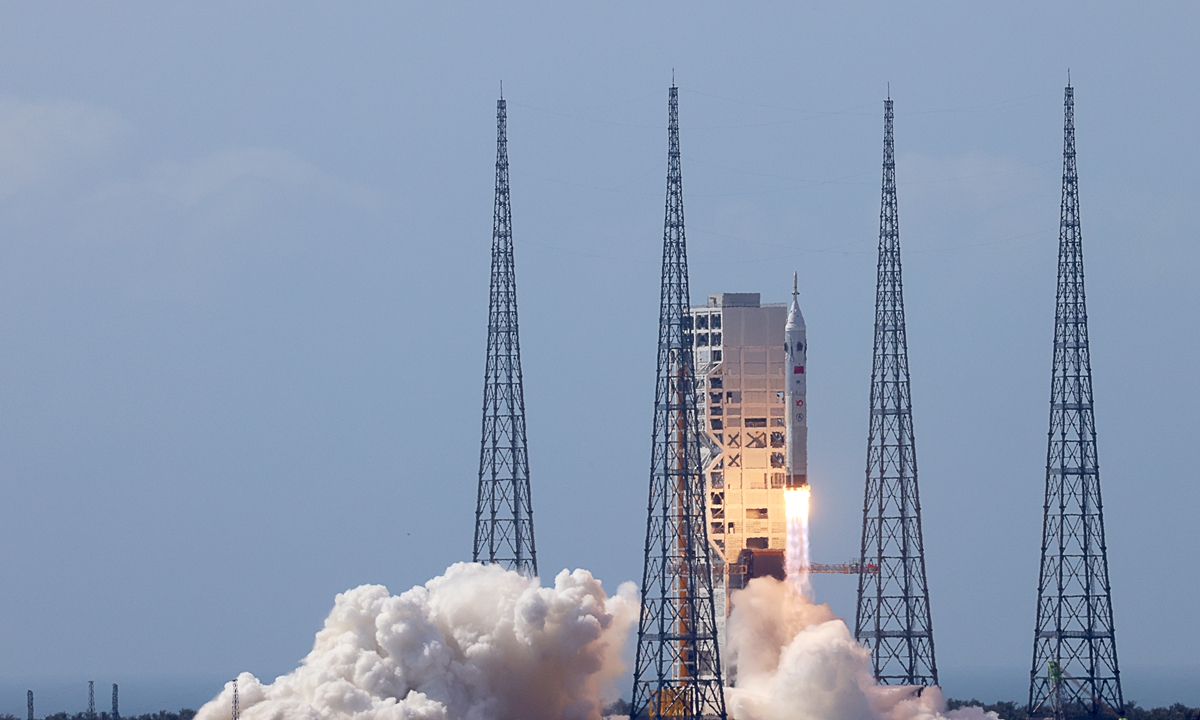
The Mengzhou spacecraft lifts off with the Long March-10 rocket at Wenchang Space Launch Site in the southern island province of Hainan on February 11, 2026. Photo: Fan Wei/GT
China on Wednesday successfully conducted a low-altitude demonstration and verification flight test for its Long March-10 carrier rocket in the southern island province of Hainan, the China Manned Space Agency said.
The test marked another major developmental flight in China's manned lunar exploration program following earlier trials, including the tethered ignition test of the Long March-10 carrier rocket, the zero-altitude abort flight test of the Mengzhou crewed spacecraft, and the comprehensive landing and liftoff verification of the Lanyue lunar lander.
The Global Times reporter learned from the Wenchang Space Launch Site on Wednesday that during the maximum dynamic pressure abort test, the Mengzhou crewed spacecraft lifted off with the ignition of the Long March-10 rocket's core first stage.
After about one minute of ascent, at an altitude of around 10 kilometers above sea level, the spacecraft sequentially carried out key actions including separation of the service module and return capsule, engine ignition, attitude adjustment, and separation of the escape tower from the return capsule.
When the return capsule descended to an altitude of around 8 kilometers, three parachutes with a total area exceeding 2,400 square meters deployed smoothly, decelerating the capsule from about 80 meters per second to below 10 meters per second, ultimately ensuring a safe splashdown in the designated sea area. China's first maximum dynamic pressure abort flight test was declared a complete success.
Firsts and highlights
According to People's Daily, the test featured multiple firsts and highlights, including a new rocket model, a new spacecraft model, a new launch pad, and new missions involving the maritime recovery of both the rocket and spacecraft. Both the rocket and spacecraft used in the test were in their initial prototype configurations. The rocket's core first stage had previously completed two tethered ignition tests, while the spacecraft's return capsule had undergone a zero-altitude abort flight test.
The test also marked the first low-altitude flight test of the Long March-10 carrier rocket. The Long March-10 is a new-generation launch vehicle developed to support China's manned lunar missions. Featuring a series of rockets with two models and multiple configurations, it is expected to play a key role in achieving the country's goal of a manned lunar landing by 2030.It adopts a "three-and-a-half-stage" configuration, stands about 90 meters tall, and generates a liftoff thrust of roughly 2,700 tons. It is currently China's largest launch vehicle and the only one capable of sending both a crewed spacecraft and a lunar lander into translunar orbit. The test verified the functional performance of the rocket's core first-stage ascent and recovery flight phases.
The test marked the first powered flight of the Long March-10 rocket in its initial prototype configuration, China's first maximum dynamic pressure abort test of a spacecraft, and China's first maritime splashdown of both a crewed spacecraft return capsule and a rocket first stage, per People's Daily.
Unlike the Shenzhou crewed spacecraft, in which the rocket is responsible for the escape and rescue system in the event of a launch failure, the newly developed Mengzhou crewed spacecraft features an integrated escape and rescue system borne by the spacecraft itself. The Mengzhou spacecraft's launch escape tower is part of the spacecraft.
Deng Kaiwen, a technical expert with the China Aerospace Science and Technology Corporation, told the Global Times on Wednesday that the maximum dynamic pressure abort flight test simulated an emergency occurring when the rocket reaches the point of maximum dynamic pressure at an altitude of about 11 kilometers during ascent. Under such conditions, the spacecraft must overcome extremely harsh aerodynamic environments to ensure a safe abort and astronaut rescue.
During this mission, the core first stage of the Long March-10 rocket also carried out verification of key technologies including high-altitude secondary engine restart and hover ignition.
Zhu Pingping, a technical expert at the China Aerospace Science and Technology Corporation (CASC), told the Global times that during the descent phase, the core first stage completed two engine restarts: one high-altitude restart to perform trajectory adjustment, and another hover ignition prior to landing to lay the groundwork for precise recovery. "This places extremely high demands on engine reliability, propellant management, and ignition timing control."
The mission also tested an innovative core stage recovery approach, using a simulated "net-based recovery mode" in which the rocket landed at a mock splashdown point near a recovery vessel to assess coordination between the rocket and the recovery system, providing experience for future real recoveries.
At 12:20 pm, maritime search and rescue teams also completed the recovery of the spacecraft return capsule. This marked China's first sea-based search and recovery operation for a crewed spacecraft, providing valuable experience for future space station application and development missions as well as manned lunar exploration tasks, according to China News Service.
The Mengzhou crewed spacecraft is primarily designed for China's manned lunar exploration missions, while also supporting operations in low-Earth orbit space station missions. Its return capsule is capable of multiple reuses.
The flight test also marked the first use of a newly built launch pad at the Wenchang Space Launch Site dedicated to manned lunar missions.
Zhong Wen'an, chief engineer of the Xichang Satellite Launch Center, told the Global Times on Wednesday that the mission used a Long March-10A core-stage test rocket to launch a dedicated Mengzhou spacecraft verification vehicle equipped with an escape tower from Launch Pad No. 3 at Wenchang. The payloads also included lunar spacesuits for astronauts, humanoid dummies, and mechanical test dummies.
"This test mission is a milestone in the development of the Long March-10 series rockets and the Mengzhou crewed spacecraft, as well as an innovative exploration of rocket recovery and reusability technologies. It will provide important support for China's manned lunar exploration program and the space station application and development program," Zhong said.
RELATED ARTICLES