Islands in sight
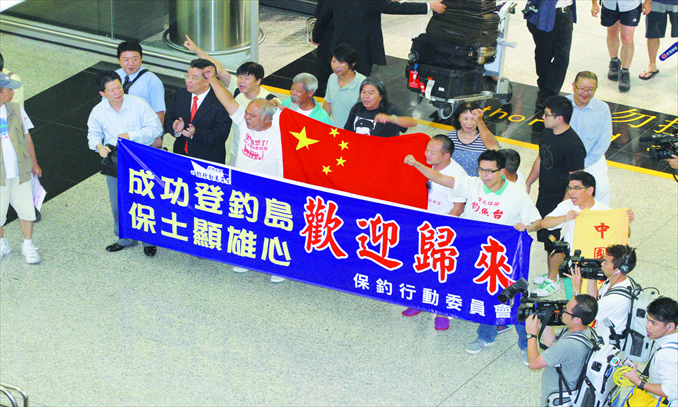
About one nautical mile from the Diaoyu Islands, the fishing boat was severely damaged by repeated collisions with Japanese patrol vessels. Wu Xiyao jumped into the water, made it ashore and planted a Chinese flag that he had been carrying for six years.
Dozens of armed Japanese coast guards patrolled the island. Wu and other crew members managed to make it about 40 meters before being seized.
Wu, 45, from Macao, is among 14 Chinese activists who went to sea to assert China's sovereignty over the Diaoyu Islands. They were arrested by the Japanese upon arrival on August 15 and released two days later.
Simple motives
These grass-roots activists have been making waves around the Diaoyu Islands for decades. Although motivated by "heroic and patriotic sentiments," the activists often find themselves in an awkward position as their government may not welcome the diplomatic ripples they cause. However, they are determined to keep up their actions and push the government to resolve the disputes.
For people like Wu, the motive is pure and simple. "It is a matter of national esteem and pride," Wu, the director-general of a trade union in Macao, told the Global Times on Tuesday.
The purpose of the grass-roots campaigns is to grab the government's attention and hopefully exert some pressure so that the country may take back the Diaoyu Islands, which are currently controlled by Japan.
These efforts started among the overseas Chinese diaspora in the 1970s when Japan set up a monument on the island to declare its sovereignty, and soon spread to China.
In 1996, the then Japanese foreign minister Yukihiko Ikeda said during a visit to Hong Kong that the Diaoyu Islands belonged to Japan. A new round of protests ensued and people began sailing out to the islands, attempting to prove China's sovereignty.
Groups were formed to defend this cause in the mainland, Hong Kong, Taiwan and Macao. Though these groups did have exchanges, no unified organization existed until earlier this year when the World Chinese Alliance in Defense of the Diaoyu Islands (WCADD) was founded.
"It shows that we have agreed that defending Diaoyu concerns all of us as Chinese," said Huang Hsi-lin, director of the alliance and also head of the Chung Hwa Paotiao Alliance, a Taiwanese organization defending Chinese sovereignty over the Diaoyu Islands. Huang, 50 and a former congressman, now devotes most of his time as an activist defending Diaoyu.
Despite rifts between the mainland and Taiwan or Hong Kong, the activists believe these spats do not affect their consorted efforts to defend the islands.
Huang believes the Diaoyu Islands could be a good starting point for the mainland and Taiwan to resolve their political differences.
"We hope to push the mainland and Taiwan authorities closer together in dealing with the islands," said Huang, who takes the Chinese national flag with him whenever he goes on missions to land on Diaoyu.
Cash-strapped
As grass-roots NGOs, money can be a problem. The Action Committee for Defending the Diaoyu Islands in Hong Kong, which organized the recent voyage, has its own boat, the Baodiao II, bought back in 2005. The maintenance and fuel costs run high though and no insurance companies will insure the boat given the risks.
Activists in Taiwan on the other hand have to rent boats, and not many people are willing to do so, for fear of clashes with the Japanese, said Huang.
Japanese coast guards are controlling the waters around the islands and do not hesitate to chase and collide with Chinese boats.
Chan Miu-tak, chairman of the action committee in Hong Kong, was on a ship that was sunk by Japanese patrol vessels in 1998.
In 2008, a Taiwan fishing boat was also sunk in the waters near Diaoyu. In 2010, Japanese authorities tried to press charges against the captain of a Chinese trawler that collided with Japanese patrol boats.
Besides a money shortage, facing the elements, and clashing with the Japanese, another major difficulty is the attitude of the authorities.
In the most recent mission for example, Taiwan activists were not able to participate because local authorities closed off the port and would not let them go, said Huang.
Wu leads the grass-roots campaign to defend the Diaoyu Islands, but has been unable to get his group registered for the last eight years. "The Macao government denied our application, saying that we are a political group, despite the fact that there are many other political groups in Macao," he said.
Since 2009, the Hong Kong SAR government has prohibited activists from going out to sea, using excuses such as the use of a fishing boat for non-fishing activities. "They also said there were foreign navy ships that might clash with, and it was not safe," Chan told the Global Times.
Before the landing on August 15, they had tried six times to sail this year but had previously not been able to enter the open sea, said Chan, 67, who quit the restaurant business to devote himself to the campaign.
Activists are often considered to be troublemakers. Tong Zeng, head of the Beijing-based China Federation of Defending Diaoyu Islands, recalled being constantly harassed by authorities in the 1990s. Protests and demonstrations were often obstructed by the police.
"The authorities sometimes see us as the opposition, as people that should be controlled, in order to maintain stability," said Tong, 56, to the Global Times. A law graduate who championed civil compensation lawsuits against the Japanese government and companies in the 1990s, Tong now owns an investment company in Beijing.
Now, he says the situation is improving as they have more space to express their opinions online and the government is also more active in asserting the country's sovereignty by sending out patrols.
After the activists were arrested by Japanese coast guards, the Chinese foreign ministry voiced strong objection and demanded Japan to release the crew and ensure their safe return. The activists were released two days later. Many consider this to have been a minor success for the grass-roots efforts, compared with previous encounters with the Japanese.
Public rumblings
However, public opinion still widely criticizes the government for being too "soft" on the problem.
"I think it's because the government does not echo the patriotic enthusiasm of the public, and that needs to change," said Tong.
Huang doesn't hide his discontent with the Taiwan authorities. This time, activists in Taiwan were supposed to meet the Hong Kong vessel but the Taiwan authorities did not let them go.
"People are not happy with how the mainland handles the issue, and we do feel sometimes it is not assertive enough," said Huang.
Diplomats have a different perspective when handling such issues, said Ma Zhengang, former ambassador to the UK, at a seminar on the Diaoyu Islands in Beijing on Sunday. "In foreign affairs, we have to weigh the pros and cons, and also the timing; we need to look at the long-term, the big picture," he said.
The activists might be more impulsive. Fang Xiaosong, one of the activists who landed on the island, does not even know how to swim.
Determined, the activists say they are not radicals but simply concerned citizens who feel the urgent need to take action. Wu considers himself a nationalist, but not irrationally so. Tong said he is "neither a leftist nor a rightist."
"I don't think we can solve the problem with radical behavior. It needs wisdom and rationality," said Huang.
Over 16 years, there have been dozens of voyages but only three have landed on the islands. The recent landing was partly in response to renewed Japanese provocation, as seen in July when some Japanese politicians announced plans to buy the islands in August.
Soon after Wu returned home, news came that Japanese right wing activists also landed on the Diaoyu Islands on Sunday.
In response, Chinese people in cities across the country, including Shenzhen, Hangzhou and Hong Kong, took to the streets to protest this action. Some called for the boycotting of Japanese products and some Japanese brand cars were smashed.
The Diaoyu activists denounce these kinds of acts. "That's too irrational and we don't want that," Li Yiqiang, deputy director of WCADD, told the Global Times. "We will never admit radical nationals, like those who smash Japanese products, into our committee," Ko Wah, a spokesperson for the committee in Hong Kong, was quoted as saying by the Xiaoxiang Morning Herald on Wednesday.
The activists are eager to reassure that they are not trying to cause trouble but only expressing their patriotism.
"We understand that the government must solve the problem. We are only the facilitators," said Li, who owns an Internet café in Xiamen, Fujian Province. According to media reports, he was arrested in 2007 when he protested against a planned PX chemical factory in the city.
The grass-roots hope for more direct and smooth communications with the government. "We want to cooperate with the government, in order to solve the problem sooner," said Li.
Timeline of voyages
-September 26, 1996: The boat "Baodiao" arrived at Diaoyu and was sunk in a collision. David Chan, a Hong Kong political activist, drowned.
-October 6, 1996: A fleet of fishing boats sailed out to the islands from Taiwan. Activists landed on October 7 and planted a Chinese flag.
-2003: Activists from the mainland, Hong Kong and Taiwan set off on joint voyages in June and October. On October 7, they were stopped by Japanese navy ships and planes.
-March 26, 2004: Seven activists from the mainland landed on the islands.
-August 15, 2012: 14 people, including four crew members and two reporters, arrived at Diaoyu. Five activists landed on the islands. Among the activists, six were from Hong Kong, one from Macao and one from Henan.