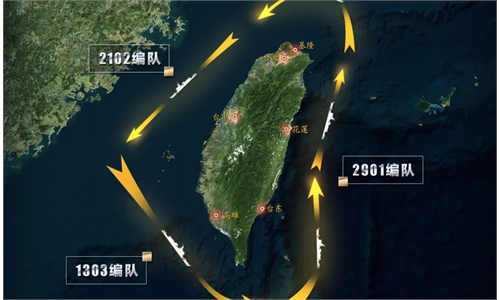
CCG, GT jointly release poster on law enforcement patrol off Taiwan, outer islands, showing tighter control
By Fan Wei, Chen He and Published: Dec 29, 2025 02:21 PM

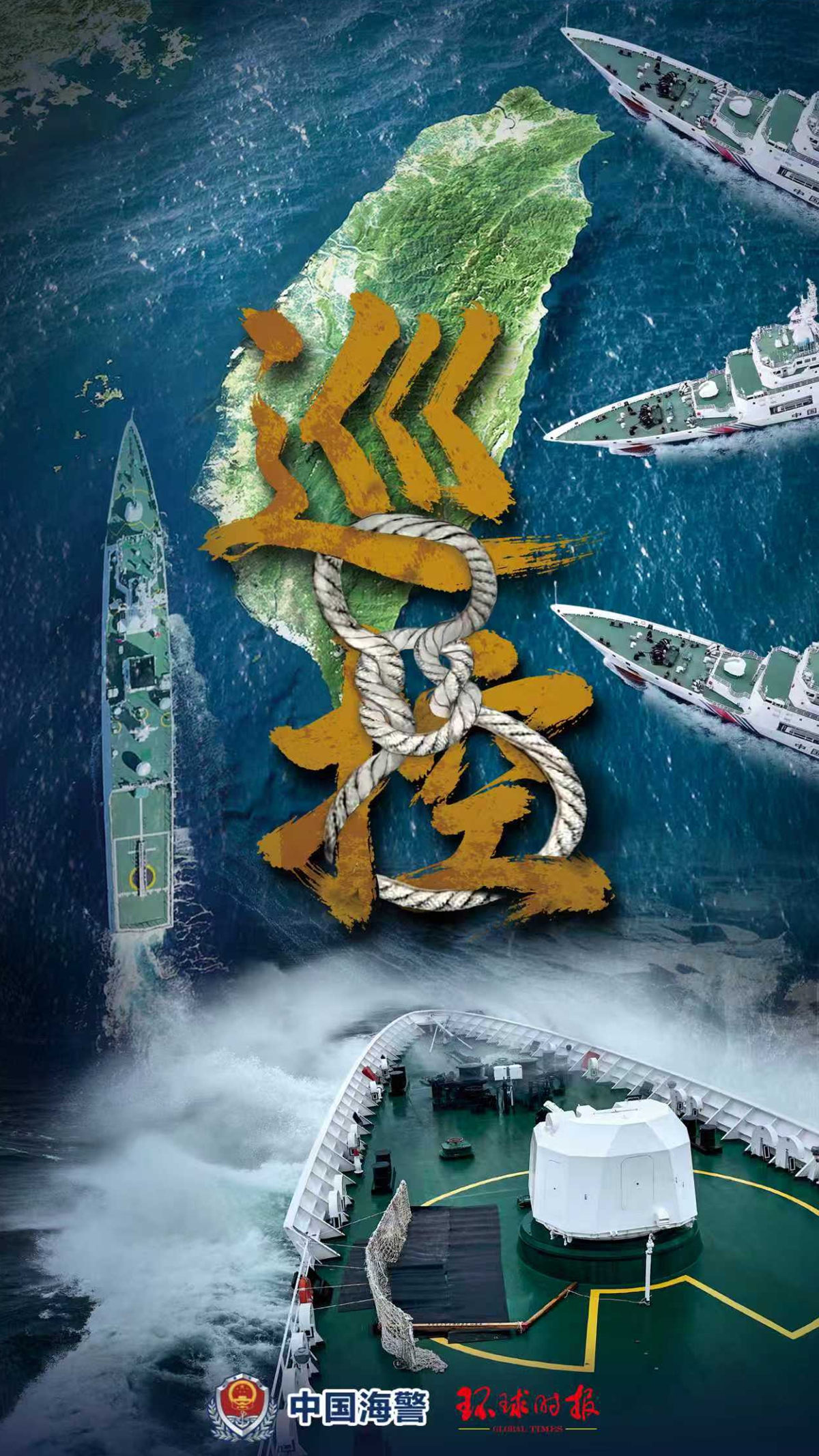
Photo: Chen He/GT
Zhu Anqing, spokesperson of the East Sea Bureau, the China Coast Guard (CCG) said that from Monday, the Fujian Coast Guard organized task forces to carry out comprehensive law enforcement patrol in the waters off the Taiwan Island, the Matsu and Wuqiu Islands. These activities were carried out to exercise the jurisdiction over the Taiwan Island and its attached islets in accordance with the one-China principle.
Meanwhile, the CCG, in collaboration with the Global Times, has released a poster titled "Patrolling and Controlling the Taiwan Straits," which vividly illustrates the profound significance behind the CCG's patrol and law enforcement operations through abundant details.
In the poster, multiple CCG vessel formations are depicted approaching Taiwan Island from three directions: north, southwest, and east, at close range. The eastern side of Taiwan Island is shown to be heavily guarded, with several CCG vessels enforcing a blockade. This aligns with the mission objectives of the CCG in this operation.
The Global Times learned that during the patrol and law enforcement operation, the CCG deployed multiple vessels, focusing on securing the maritime channels to the north, southwest, and east of Taiwan Island. They closely enforced blockade over the ports and docks in Keelung, Tainan, Kaohsiung, and Hualien. Among these actions, a concentration of vessels was assembled east of Taiwan Island to deter the "Taiwan independence" forces from colluding with external actors in seeking foreign support.
Furthermore, the poster prominently features the mission's core theme of "patrolling and controlling" in large font, visually reinforced by a "lock" formed from elements of the CCG vessel's mooring ropes. Notably, the rope in the design is tied with a square knot.
The Global Times learned that among the knots commonly used by CCG law enforcement personnel in their daily operations, the square knot is both simple and practical, known for its characteristic of tightening more firmly the harder it is pulled. The choice of the square knot pattern also symbolizes the profound meaning that "the more the 'Taiwan independence' separatist forces jump, the tighter the strangulation will become."
Giving more details of its patrol activities, the CCG said in a separate statement that on Monday, the Fujian Coast Guard organized task forces to carry out law enforcement patrol in the waters surrounding China's Taiwan Island, conducting drills on subjects of joint protection of fishing activities, identification, and verification, as well as the interception and detention of operations against unwarranted vessels. The drills tested capabilities of effective jurisdiction and efficient law enforcement.
A third CCG statement stated that the Fujian Coast Guard organized task forces to carry out comprehensive law enforcement patrol in the waters off the Matsu and Wuqiu Islands on Monday, focusing on subjects of identification and verification, as well as control and expulsion operations. The drills tested capabilities of rapid response and emergency handling.
The CCG also released an illustration of its vessel task forces' law enforcement patrol off Taiwan Island in accordance with the one-China principle.
The illustration shows that the CCG's 1302 Formation, 1306 Formation, 2203 Formation, and 2204 Formation weaved a tight blockade around the north, east, south, southwest of Taiwan Island with red mooring lines and elegant Chinese knots, effectively encircling it.
It is a rope that encircles the province of Taiwan Island, tying a Chinese knot and binding the shared lineage and securing the reunification. The Global Times learned that the illustration released by the CCG takes the Chinese knot and mooring rope as its central symbols, intertwining the sovereignty narrative that "Taiwan is a province of China" with the cultural symbolism of "peace in the Taiwan Straits and reunification of the homeland." This has evoked an emotional resonance, encapsulated in the phrase, "One rope encircles the province, one knot reunifies China."
RELATED ARTICLES