Chinese yuan strengthens to three-year high on back of China’s economic resilience
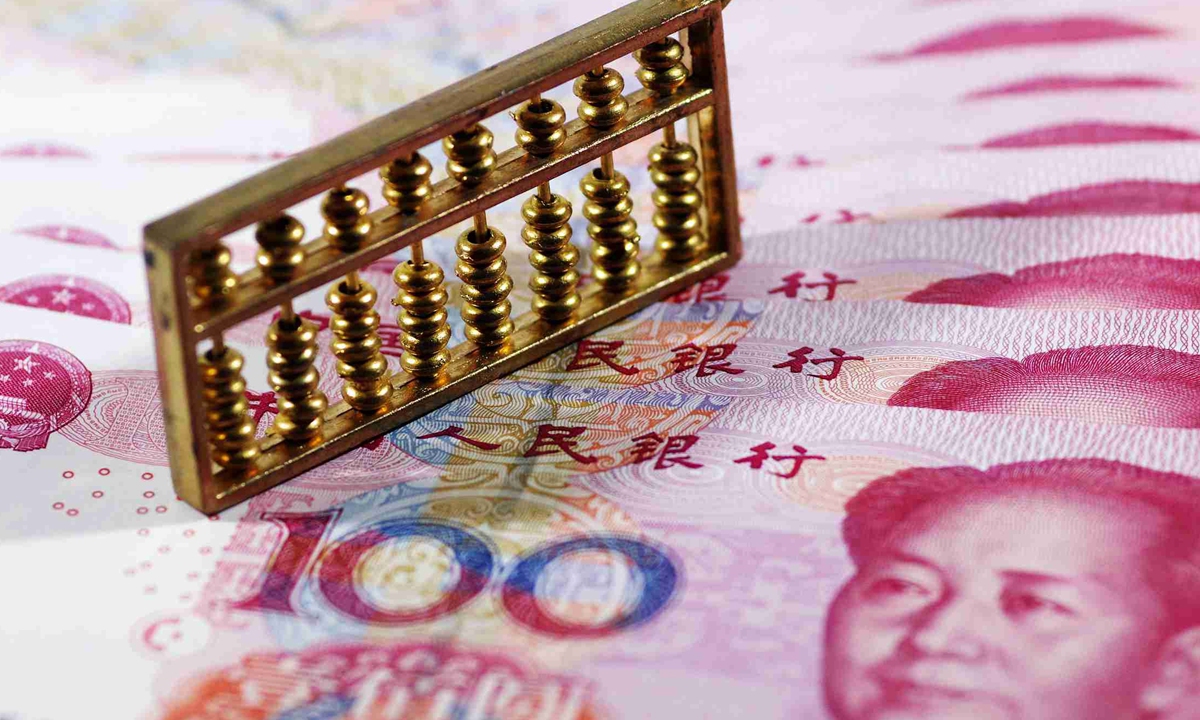
Chinese yuan Photo:VCG
The yuan strengthened to 6.82 against the US dollar on Tuesday morning, the highest level in more than three years. The yuan's robust performance underscores the resilience of China's economic fundamentals and demonstrates the return of rational foreign exchange market expectations, Chinese analysts said, noting that a rational global asset portfolio should give due consideration to yuan-denominated assets.
The spot exchange rate of the yuan against the US dollar opened at 6.8209 on Tuesday, and subsequently strengthened to 6.82, marking the first time it had reached this level since March 24, 2023. As of 2 pm Beijing time, the onshore yuan touched 6.8182, while the offshore yuan stood at 6.8156, according to the Beijing Daily.
The People's Bank of China (PBC), the country's central bank, on Tuesday set the central parity rate for the yuan 64 basis points stronger than the previous day at 6.8593. This daily fixing, around which the onshore yuan is permitted to trade 2 percent higher or lower, is announced each morning.
"The robust performance of the yuan amid notable fluctuations in the global foreign exchange market is a joint effect of multiple factors, but the core lies in the solid fundamentals and strong resilience of the Chinese economy," Li Changan, a professor at the Academy of China Open Economy Studies at the University of International Business and Economics, told the Global Times on Tuesday.
Li pointed to recent positive macroeconomic figures. For instance, the purchasing managers' index for China's manufacturing sector stood at 50.4 in March, up 1.4 from the previous month, rebounding into the expansionary zone and signaling an impressive pickup in economic vitality, he said.
Tian Lihui, head of the Institute of Financial Development at Nankai University, told the Global Times on Tuesday that the recent trend in the yuan demonstrated the return of rational foreign exchange market expectations, while marking an improvement in the yuan's elasticity.
"Supported by both China's export resilience and policies to expand domestic demand, the yuan is likely to remain stable with a slight upward bias and two-way fluctuations," Tian said.
Tian said that amid rising geopolitical tensions, yuan-denominated assets are increasingly becoming global safe-haven assets.
"In the short term, the yuan will increasingly play an anchor currency role within regional economic and trade circles. In the medium to long term, driven by the dual engines of digital currency and green finance, the yuan is expected to upgrade from a transaction currency to a reserve currency," Tian said, noting that a rational global asset allocation portfolio should give consideration to the yuan.
In March, the daily transaction value via the Cross-Border Interbank Payment System (CBIPS) reached 920.5 billion yuan ($134.77 billion), surging 48 percent month-on-month and hitting a new record high for nearly a year, the Securities Daily reported on Tuesday, citing data from the CBIPS.
PBC Governor Pan Gongsheng said during the China Development Forum 2026 that the steady promotion of high-level opening-up of the financial sector, deepening financial market connectivity and cross-border payment system interoperability will facilitate broader investor participation in China's financial markets.
Multiple countries, international development institutions, financial institutions, and large enterprises issued panda bonds worth more than 170 billion yuan in 2025, and the scale of offshore yuan bonds issued in Hong Kong was even larger.
"The yuan will continue to attract inflows of foreign capital, backed by its stable exchange rate, strong safe-haven attributes, the relatively high allocation value of yuan-denominated assets, and its rising international status," Li said.
RELATED ARTICLES