Russian naval flotilla visits South China’s Zhanjiang, showcasing routine exchanges and strategic trust: Chinese experts
By Feng Fan and Published: Apr 15, 2026 07:22 PM

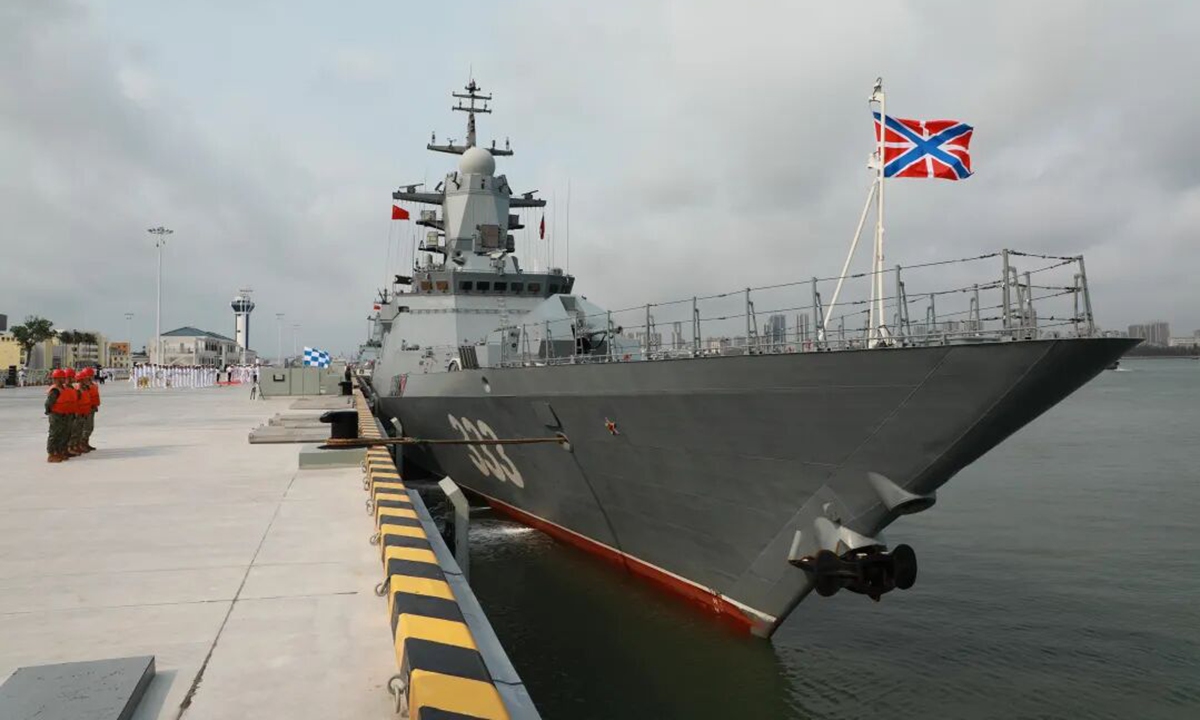
This photo taken on April 15, 2026 shows a corvette of a Russian navy fleet at a military port in Zhanjiang, South China's Guangdong Province. Photo: China Military Bugle
A Russian naval flotilla composed of the corvettes Sovershennyy and Rezkiy, along with the medium seagoing tanker Pechenga, arrived in Zhanjiang, South China's Guangdong Province, on Wednesday morning, kicking off a five-day friendly visit, according to Xinhua News Agency.Chinese experts said that the visiting vessels are of new models in the Russian Navy, and such visit reflects a high level of strategic mutual trust and traditional friendship between the Chinese and Russian navies, and will help strengthen maritime security cooperation between the two countries.
At around 9 am, under the guidance of the Chinese Navy vessel Chenzhou, the Russian ships, flying the national flags of both countries, slowly docked at a military port in Zhanjiang. A welcoming ceremony was held on the pier by the Chinese side, according to Xinhua.
During the visit, the commander of the Russian flotilla will meet with officers from the navy of PLA Southern Theater Command and representatives of the Zhanjiang city government. Naval officers and sailors from both sides will also tour each other's vessels and participate in activities including deck receptions, professional exchanges and sports events.
The visiting ships are affiliated with Russia's Pacific Fleet and have previously taken part in China-Russia naval cooperation activities. The Sovershennyy has participated multiple times in joint maritime patrols between the two countries and visited Shanghai in 2023. The Rezkiy took part in the Exercise Joint Sea-2024, while the Pechenga visited Qingdao in 2024, Xinhua reported.
Song Zhongping, a Chinese military affairs expert, told the Global Times on Wednesday that the visiting Russian Navy corvettes are relatively new surface combatants from the Pacific Fleet.
"The visiting Russian warships possess air defense capabilities as well as strong anti-submarine and anti-ship strike capabilities, along with a certain level of land-attack capability. They are typical multi-role Russian vessels capable of conducting independent operations," Song said. "Russian ships have previously carried out military drills in the South China Sea, and their visit to the navy of PLA Southern Theater Command for military exchanges is also a routine practice."
According to Russia's TASS news agency, both Sovershennyy and Rezkiy are Project 20380 corvettes. These multipurpose Project 20380 corvettes are ships designed for operations in the near sea zone, capable of engaging surface ships and submarines and providing fire support during amphibious operations.
The corvettes' full displacement reaches about 2,200 tons, with a top speed of 27 knots and an operational range of 4,000 nautical miles. Their main armament includes the Uran anti-ship missile system and the Redut air defense missile system. They are also equipped with artillery and anti-submarine weapons and can carry a helicopter, according to the TASS.
Zhang Junshe, another Chinese military affairs expert, told the Global Times on Wednesday that the visit is a routine exchange reflecting a high level of strategic mutual trust and the long-standing friendship between the Chinese and Russian navies.
Noting that the Russian corvettes are among the newer and more capable ships in the Russian Navy, Zhang said that such visits help deepen mutual understanding and enhance cooperation in maritime security, contributing to regional stability.
According to Xinhua, the visit is part of a routine friendly exchange between the two navies, aimed at further enhancing friendship and mutual trust and deepening practical cooperation. It is not directed at any third party and is unrelated to the current international and regional situation.
Zhang noted that frequent mutual visits between the Chinese and Russian navies are a common international practice that helps improve bilateral understanding and cooperation, stressing that such routine port calls are not linked to geopolitical developments.
RELATED ARTICLES