Brazil reclaiming top global ranking for Chinese investment reflects potential as co-op diversifies: expert
By Published: May 07, 2026 10:05 PM

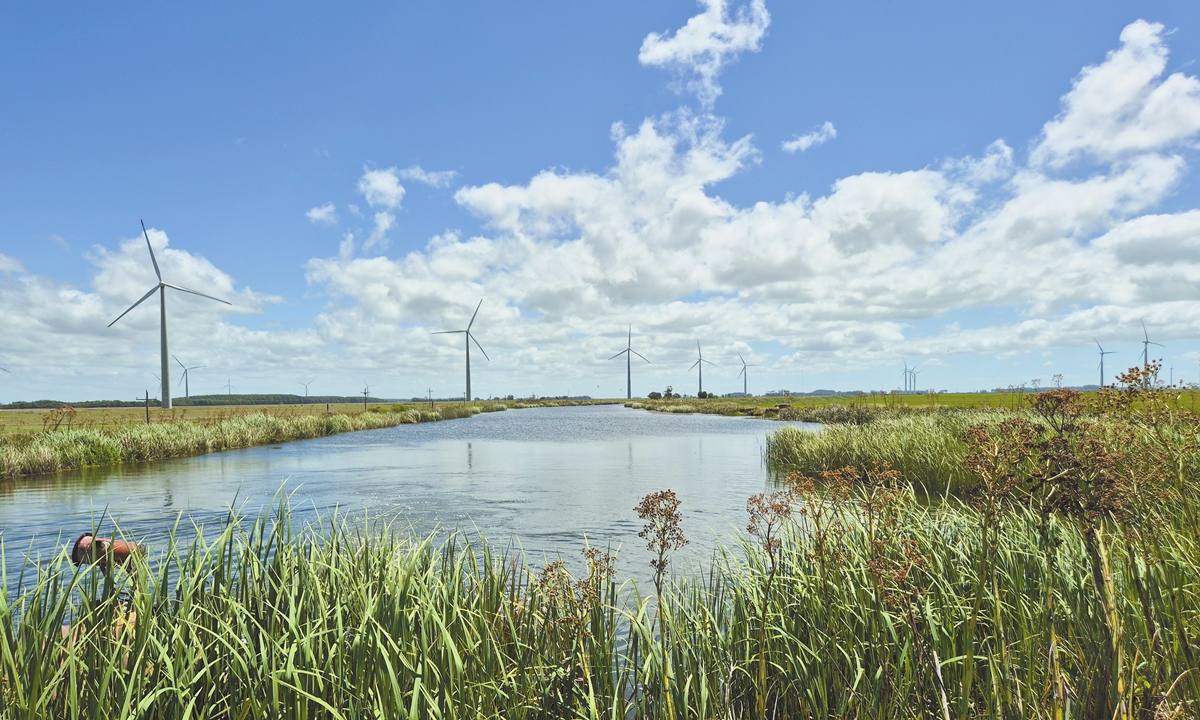
The SVP project in Brazil built by the China General Nuclear (CGN) Power Group Photo: Courtesy of CGN
A rise in Chinese investment to Brazil has helped the South American country to reclaim the top spot globally for investment from China in 2025, according to Reuters, citing a report released on Thursday by the Brazil-China Business Council (CEBC).
In 2025, Brazil attracted 10.9 percent of total outbound capital from China, followed by the US and Guyana, with 6.8 percent and 5.7 percent, respectively, the report said.
Chinese analysts said that while the ranking results may vary depending on the statistical methodology used, the rise in Chinese investment to Brazil has reflected the growing ties between the two countries, with economic cooperation deepening in recent years from trade to investment and supply chain collaboration.
According to the CEBC report, Brazil received $6.1 billion in Chinese investment across dozens of projects, a 45-percent increase in capital compared to 2024, as Chinese companies worked to diversify their presence in Latin America's largest economy and increase their stake in the country's clean energy and mining sectors.
Over the past five years, Brazil has ranked between first and fifth among the world's top destinations for Chinese investment, having claimed the top spot in 2021, CEBC said.
While the electricity sector continued to lead Chinese capital flows into Brazil, mining saw a surge of renewed interest, with investments tripling in 2025, per the report.
The automotive sector also attracted significant investment, ranking third overall in 2025 and accounting for 15.8 percent of total investment by Chinese corporations in Brazil.
Yue Yunxia, a deputy director of the Institute of Latin American Studies at the Chinese Academy of Social Sciences, told the Global Times on Thursday that China-Brazil economic and trade cooperation has evolved from simple trade in goods to commercial investment, and further toward localized supply chain integration.
"In the future, there is strong potential for localized production. The complementarity between the two countries' supply chains and value chains is very strong," Yue said.
Zhou Mi, a senior research fellow at the Chinese Academy of International Trade and Economic Cooperation, told the Global Times on Thursday that Chinese companies have significantly accelerated their outbound investment in recent years, particularly in resource-rich sectors where Brazil holds strong appeal.
As Brazil hosted the BRICS Summit last year and its government actively sought international cooperation to advance clean energy and other industries, mutual trust with China further strengthened, Zhou said.
Geopolitical factors have also come into play, as mutual benefits and shared needs drive corporate decisions, according to Zhou.
Notably, a number of Chinese companies are drawn to Brazil's pivotal role within regional and broader Latin American markets, eyeing the country as a gateway to expand across the region, Zhou said.
Tulio Cariello, content and research director at CEBC, told the Global Times on Friday via email that Brazil became the country that attracted the most Chinese investment worldwide in 2025 due to a combination of factors: a large consumer market, the availability of clean energy for industrial projects, one of the world's most advanced banking systems, qualified workforce across multiple sectors, and a wide range of natural resources, from oil to critical minerals.
In addition, Brazil has clearly established itself as a major destination for productive capital in the context of companies seeking newer markets amid geopolitical tensions, Cariello said.
The rise in Chinese investment in Brazil came as "an array of Chinese businesses are now courting the country's more than 200 million consumers," according to a separate Reuters report.
Since last year, an increasing number of Chinese companies, including Chinese ice cream and beverage chain Mixue, Chinese-founded fast-fashion retailer Shein, and Chinese automaker GWM, have expanded their presence in Brazil by opening new shops and plants.
In July 2025, the two countries also agreed to further consolidate and deepen bilateral cooperation in trade, finance and infrastructure development under the framework of high-quality Belt and Road cooperation, the Xinhua News Agency reported.
Trade between Brazil and China hit a record $171 billion in 2025, up 8.2 percent year-on-year, the South China Morning Post reported in January, citing data released by the China-Brazil Business Council.
RELATED ARTICLES