EU's Industrial Accelerator Act risks 'counterproductive effects,' China Chamber of Commerce to EU warns in formal feedback to EC
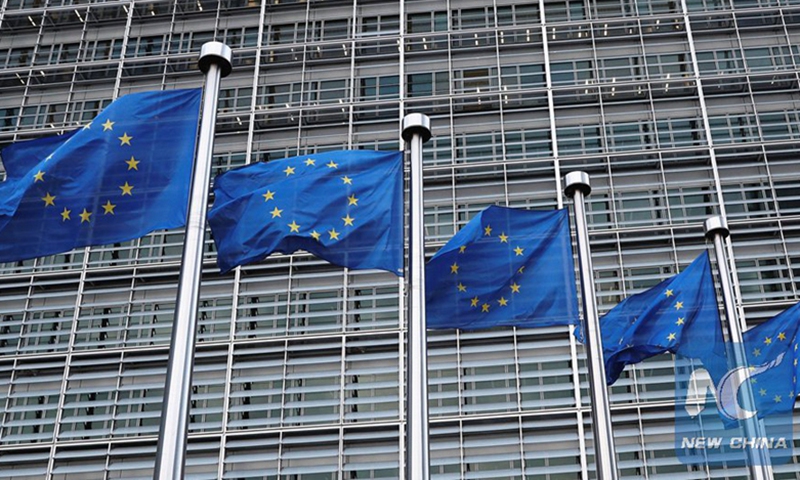
The European Union flags in front of EU headquarters in Brussels, Belgium. Photo: Xinhua
China's business chamber in the EU submitted feedback to the European Commission on the bloc's proposed Industrial Accelerator Act (IAA), expressing concerns over provisions related to public procurement restrictions, foreign investment conditions, and legal uncertainty, while putting forward specific amendment proposals, according to a post published Friday on the official WeChat account of the China Chamber of Commerce to the EU (CCCEU).
The CCCEU calls on the EU institutions to engage closely with industry stakeholders, including business associations, carefully assess the practical implications and compliance risks of the proposed provisions, uphold the principles of fair competition and open markets, and address outstanding concerns through constructive dialogue and consultation.
Representing more than 1,000 Chinese-invested enterprises operating across the EU in sectors including automotive manufacturing, renewable energy, the digital economy, logistics, and advanced technologies, the CCCEU noted that while the IAA aims to strengthen EU industrial competitiveness and accelerate the energy transition, several of its provisions risk producing counterproductive effects, according to the post.
Industrial policy that disregards global supply chain realities will be unable to sustain long-term investment, the chamber noted. In particular, measures that constrain advanced manufacturing sectors risk increasing production costs, reducing operational efficiency, and discouraging industrial acceleration, it added.
The EU proposal fails to address the underlying structural challenges facing EU energy-intensive industries — high energy costs, overregulation, labor shortages, and declining innovation dynamics. By shielding parts of the market from international competition and placing additional hurdles on foreign investors, the IAA risks destabilizing rather than resolving the challenges facing EU industrial growth, according to the chamber's post.
Imposing additional obligations on foreign investors creates an uneven playing field and limits the ability of EU-based companies to benefit from global innovation networks, said the chamber.
The chamber post noted that several elements of the proposal raise important questions regarding their compatibility with established principles of EU law and the EU's obligations under the WTO framework, which warrant careful scrutiny during the legislative process. "Maintaining open investment conditions, technological cooperation, and globally integrated supply chains will be essential for preserving the EU's attractiveness for large-scale manufacturing investment," it added.
The CCCEU emphasized that China-EU industrial cooperation has already made an important contribution to the EU's competitiveness. In sectors such as electric vehicles, battery technologies, and renewable energy, companies from both sides cooperate through investment projects, supply chain partnerships, and joint R&D, supporting the EU's manufacturing capacity, innovation, and supply-chain resilience.
"Measures under the IAA that may effectively disadvantage Chinese companies through procurement conditions, localization requirements, or investment-related criteria risk weakening cooperation in sectors that are central to achieving these shared objectives."
Global Times
RELATED ARTICLES