US, Iran hold follow-up talks in Switzerland amid Hormuz dispute and Lebanon tensions; expert says both sides seek ceasefire deal while bargaining through pressure
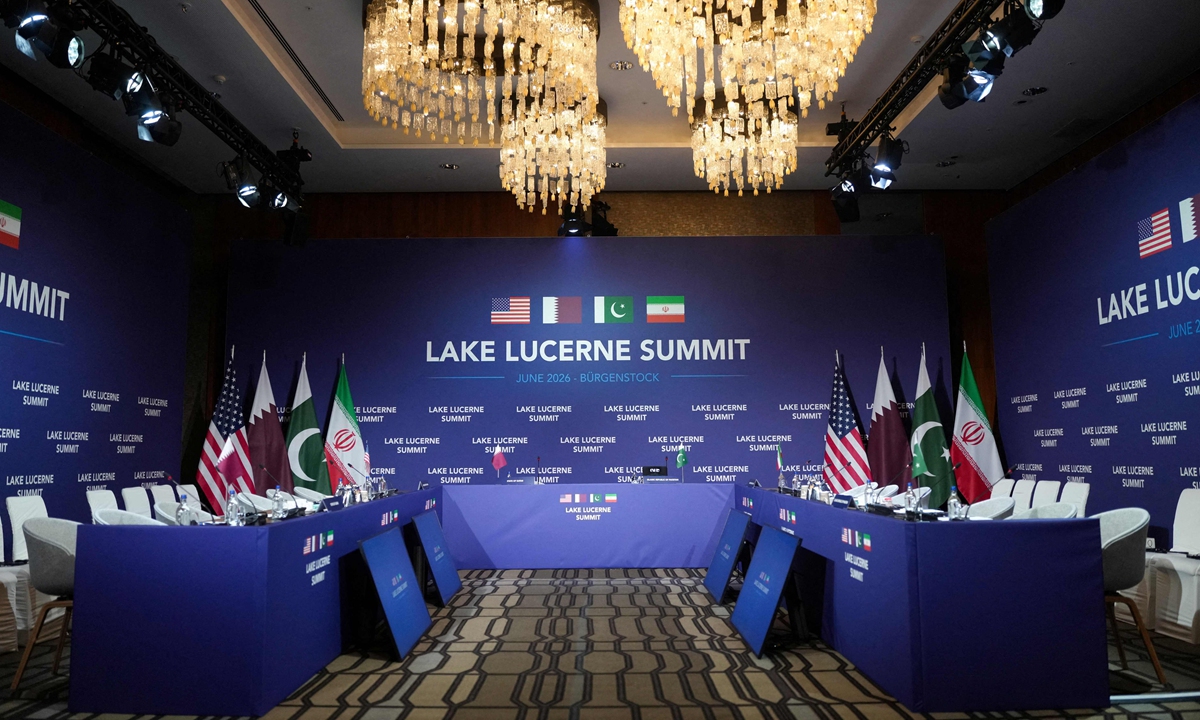
A photo shows a general view of the room ahead of a quadrilateral meeting between the US, Iran, Pakistan and Qatar at the Burgenstock luxury hotel complex in Switzerland on June 21, 2026. Photo: VCG
Iranian and US negotiators started talks on Sunday at Switzerland's Burgenstock resort for follow-up talks on the implementation of a recently signed memorandum of understanding (MOU) aimed at ending nearly four months of conflict, as tensions persisted over the Strait of Hormuz and Israeli military operations in Lebanon.
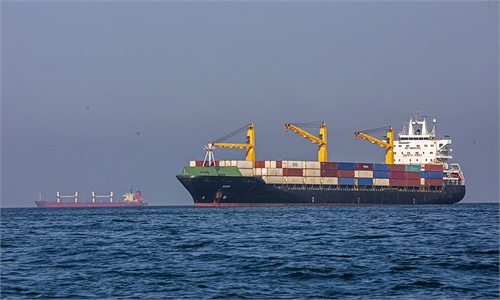
Iran announced that it had closed the key waterway after accusing Washington of failing to uphold the memorandum by restraining Israel and preventing further attacks in Lebanon, while the US military disputed Tehran's claim and said commercial shipping continued through the strait.
US Vice President JD Vance still laid blame on Iran calling it a "driver of regional instability," but he added there was "great" progress made over the last few hours. The two countries now see a "future together where everyone can work together to promote peace and prosperity," Vance said, per Al Jazeera.
He also said US President Donald Trump had asked us to "turn over a new leaf" to transform our relationship with the people of Iran.
As for the mediators, Pakistan's Prime Minister Shehbaz Sharif expressed expectations for "wonderful discussions which will lead to, hopefully, very productive results in times to come" while Qatar's Prime Minister Sheikh Mohammed bin Abdulrahman bin Jassim Al Thani thanked both the US and Iranian delegations for their efforts to make peace in the Middle East.
The head of the International Atomic Energy Agency (IAEA) Rafael Grossi is also at the site, as he said on social platform X that he met with Swiss Foreign Minister Ignazio Cassis there to discuss "recent developments regarding Iran" and other issues, per Xinhua.
Esmaeil Baghaei, spokesperson for Iran's Foreign Ministry, said the Iranian delegation "will be pressing for implementation" of the US' commitments outlined in the MOU and "seeking clarity on how exactly the other side intends to carry out those commitments."
The US delegation reportedly also include envoys Steve Witkoff and Jared Kushner, while Iran sent a senior delegation including Parliament Speaker Mohammad Bagher Ghalibaf and Foreign Minister Abbas Araghchi.
As parties meet in Switzerland, the US president says Tehran "must immediately stop their highly paid proxies in Lebanon from causing trouble," he posted on his Truth Social platform.
According to Axios, Vance reportedly said on Saturday before leaving Washington that he hopes they are going to make progress on the nuclear issue and Lebanon ceasefire issue.
The first clause of the MOU signed Wednesday states that the US and Iran have agreed to the "immediate and permanent termination of military operations on all fronts, including in Lebanon." Additionally, the memorandum adds that both sides will commit to ensuring the "territorial integrity and sovereignty of Lebanon," according to Al Jazeera,
Although Israel agreed to a renewed ceasefire with Hezbollah on Friday, its attacks in Lebanon continued into Saturday, killing at least 32 people, according to Lebanon's civil defense and state media reports, Al Jazeera reported.
Following the renewed Israeli strikes in Lebanon, the Iranian armed forces announced on Saturday that they would close the Strait of Hormuz — just three days after it reopened — alleging that America's failure to rein in Israeli attacks on Lebanon violates the new ceasefire deal.
The US Central Command said in an X post on Saturday that commercial vessels were continuing to transit the open Strait of Hormuz. There were reportedly 55 merchant ships transiting the Strait, moving large amounts of cargo and more than 17 million barrels of oil to global markets.
Zhu Yongbiao, a Middle East affairs expert with Lanzhou University, told the Global Times on Sunday that Iran's decision to continue the diplomatic process despite announcing the closure of the Strait of Hormuz appeared to reflect a pragmatic calculation, with Tehran seeking to press Washington to restrain Israel as much as possible rather than expecting it to exercise complete control.
Zhu said continued Israeli strikes could be aimed at preserving leverage, expanding its security buffer and drawing the US back into possible deeper involvement, while securing room to conduct periodic military operations even if Washington seeks to step back from the conflict.
One substantial obstacle to reaching a lasting agreement was that the memorandum remained a broad political framework, while nearly every substantive provision, including the sequencing of reciprocal steps, sanctions relief, the handling of enriched uranium, verification arrangements and the scale of US military assets in the region, could trigger major disputes once negotiations moved into technical details.
Commenting on the MOU, Chinese Foreign Ministry spokesperson Lin Jian said at a regular press conference on Thursday that China welcomes it and hopes that all relevant parties including the US and Iran will uphold the spirit of contract and implement it in good faith.
RELATED ARTICLES