Xi puts forward four-point proposal at SCO Bishkek Summit
By Ma Jingjing in Bishkek and , , Li Meng in Beijing Published: Sep 02, 2026 01:02 AM

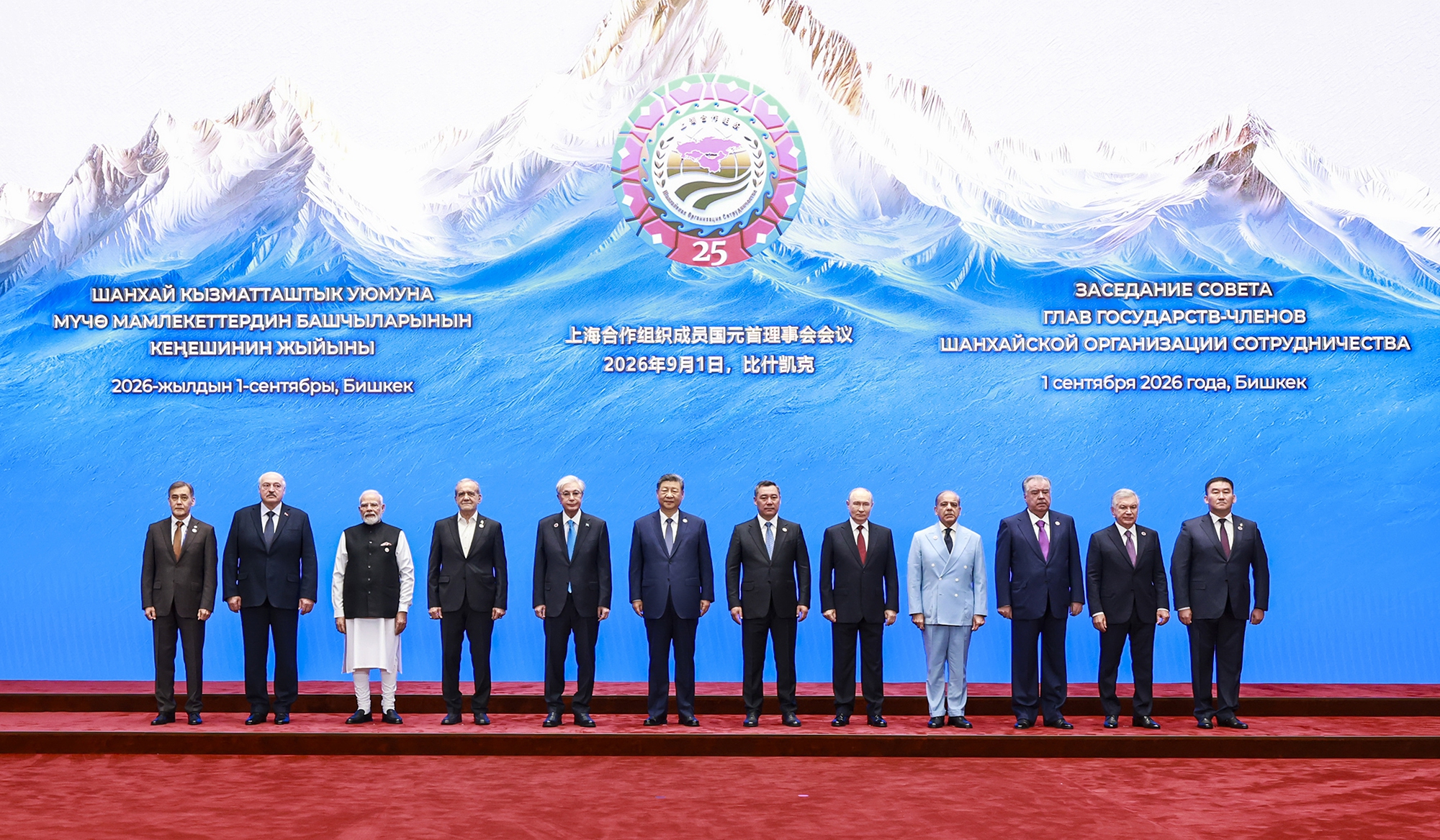
Chinese President Xi Jinping poses for a group photo with leaders of the Shanghai Cooperation Organization (SCO) member states in Bishkek, Kyrgyzstan, on September 1, 2026. Photo: Xinhua
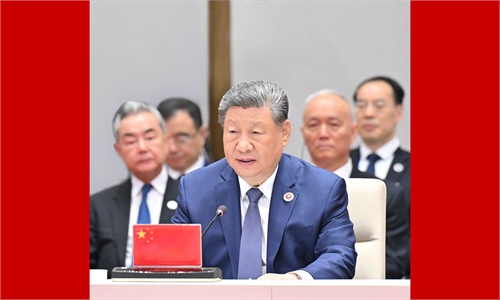
Chinese President Xi Jinping said on Tuesday that China sees the Shanghai Cooperation Organization (SCO) as a priority area for high-quality joint construction of the Belt and Road and implementation of the Global Development Initiative, according to the Xinhua News Agency.Xi made the remarks in his speech addressing the 26th Meeting of the Council of Heads of State of the SCO in the Kyrgyz capital of Bishkek.
Xi said China is ready to help build the SCO into an important platform for implementing the Global Security Initiative. China is also willing to work with all parties to implement the Global Civilization Initiative, and supports the SCO in pursuing exemplary cooperation to implement the Global Governance Initiative, Xi added.
Xi put forward a four-point proposal. He called on the SCO to stay committed to putting development first, and open up the prospects for shared prosperity.
He urged the SCO to stay committed to taking security as a key goal, and foster an environment of common security.
The Chinese leader also called on the grouping to put people first, and cement the foundation for everlasting friendship.
He urged the SCO to promote dialogue and consultation, and strive for more equitable and orderly governance.
The SCO summit wrapped up in Bishkek on Tuesday. Leaders of the member states signed and issued the Bishkek Declaration, approved the protocol on amendments and additions to the SCO Charter, the regulations on the SCO Universal Center for Countering Security Challenges and Threats and the regulations on the SCO Anti-drug Center, and adopted 28 outcome documents covering such areas as security, economic and people-to-people cooperation, and organizational development, according to Xinhua.
China will also establish an international cooperation center on AI applications for SCO countries, set up a China-SCO port economy cooperation center in Tianjin, and jointly implement 100 technological cooperation projects with SCO countries over the next three years, per Xinhua.
From blueprint to outcomes
The summit in Bishkek comes a year after the successful SCO summit 2025 in North China's Tianjin Municipality, where member states adopted the SCO Development Strategy for 2026-2035, charting the course for the organization's future development. Among the outstanding outcomes at last year's SCO summit in Tianjin is China-proposed Global Governance Initiative and observers have noted that turning blueprint into actionable, down-to-earth results has been a key feature of this year's summit.
"I read it as a shift from declaration to delivery. The four global initiatives are being anchored inside SCO mechanism, and this time with a concrete list attached," Kubat Rakhimov, executive director of Applicata - Centre for Strategic Solutions in Bishkek, told the Global Times. For Rakhimov, the Trans-Caspian International Transport Corridor deserves attention. For a landlocked country like mine, the bottleneck in Eurasian transit is no longer track - it is border-crossing capacity, customs procedure and paperwork, Rakhimov said.
Li Yongquan, an expert with Development Research Centre of the State Council, told the Global Times on Tuesday that the essence of the SCO's development in the past 25 years is that it has found the right way of coexistence featuring non-alliances, non-confrontation and not targeting any third party, while bringing countries in the region together to build a common home.
Li Xin, director of Institute for Eurasian Studies with Shanghai University of Political Science and Law, said that the Shanghai Spirit, featuring a philosophy grounded in mutual trust, mutual benefit, equality, consultation, respect for diversity of civilizations and pursuit of common development, has demonstrated enduring vitality with the successful SCO summit held in Bishkek.
As China proposed implementing the major global initiatives within the SCO platform, related efforts in building a demonstration pilot zone featuring these initiatives would be a focal point to be observed in the next few years, Li Xin said, noting that a successful model at SCO would offer a paradigm of global governance reform for the world.
Trade between China and other SCO members grew from $12.1 billion in 2001 to $523.5 billion in 2025, accounting for 8 percent of China's total foreign trade.
What began as a forum for settling borders among founding members has become the largest regional organization in the world by landmass, population, and GDP. This unique institution is transforming itself into a center of crystallization for global governance, Djoomart Otorbaev, former prime minister of Kyrgyzstan, told the Global Times.
The SCO can set an example of how countries with different ideologies and different systems can establish peaceful procedures to reach common conclusions. Ahead lie many complicated stages, but the organization will try to become a model of best practice, Otorbaev said.
China plays a pivotal role
Observers said China, as a founding member of the SCO, has played a pivotal role in shaping the platform, which is garnering more attention in the wider international community.
"China has played a very pivotal role in shaping the SCO," Manish Chand, editor-in-chief of India & World, a magazine-journal in India, told the Global Times on Tuesday, noting that there were some very good ideas China proposed, for example, the initiative on setting up the SCO Development Bank and strengthening economic linkages, trade, and investment among the SCO countries.
"The SCO has emerged, at Eurasia, a preeminent forum and preeminent multilateral grouping. A lot of countries want to join the organization because SCO's attraction lies in shaping an independent counterpoint, independent narrative, independent viewpoint on major global issues of the day," Chand said.
"China's contribution to the SCO has been substantial. It has been a pioneer state in the evolution of the SCO. The concept characterizing equality, commonality, cooperation and sustainable security advocated by China forms the guiding principle of security cooperation amongst member states," said Masood Khalid, a former Pakistani ambassador to China.
China's initiatives have found resonance not only among SCO member states but also in the wider international community, particularly in the countries of the Global South, Khalid said.
RELATED ARTICLES