China-Singapore ‘Maritime Cooperation-2026’ joint exercise opens, aiming to deepen mutual trust, boost joint response capability: expert
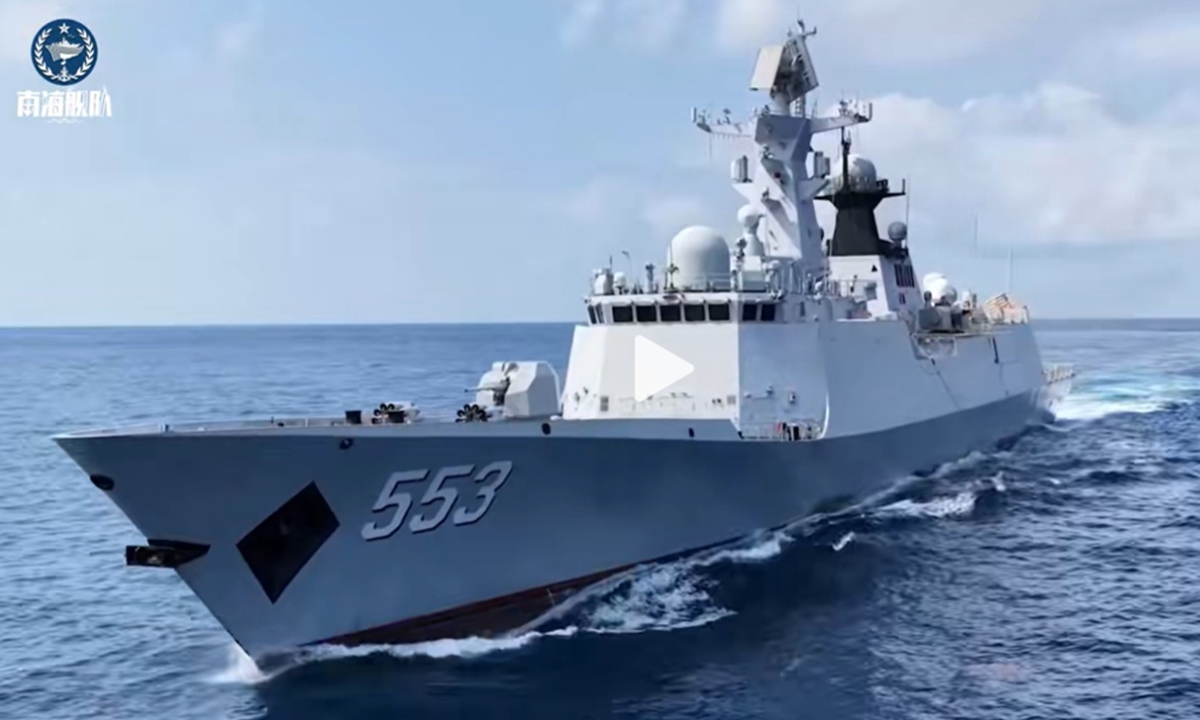
The Type 054A guided-missile frigate Dali (Hull 553) Photo: Screenshot from PLA Navy's South Sea Fleet WeChat account
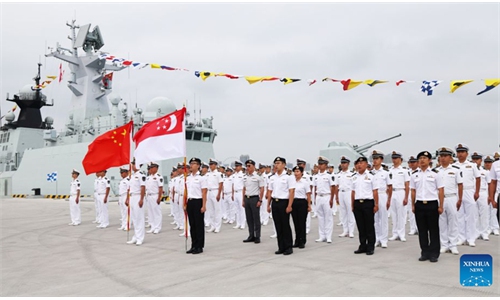
The China-Singapore "Maritime Cooperation-2026" joint exercise opened at a military port in Zhanjiang, South China's Guangdong Province, on Saturday, with representatives of participating naval personnel from both countries attending the opening ceremony, according to the Xinhua News Agency.The exercise is being held in the sea and airspace near Zhanjiang. China is represented by the Type 054A guided-missile frigate Dali, carrying shipborne helicopters and a professional exchange team, while Singapore is represented by the frigate RSS Stalwart, said the Chinese People's Liberation Army (PLA) Navy WeChat account.
The exercise consists of two phases: in-port activities and at-sea drills. During the in-port phase, senior officers from both sides held meetings and planning discussions on Friday, and hosted a deck reception. In the coming days, professional exchanges will be conducted on diving operations, submarine search and rescue, and underwater medicine.
The at-sea phase will officially begin on September 8, featuring communication drills, underway replenishment, joint surface strikes, and joint search and rescue operations, said Xinhua.
In his remarks, the Singaporean naval fleet commander emphasized that the exercise provides a valuable opportunity for both sides to learn from each other, marking another solid step forward in enhancing mutual understanding and deepening trust between the two sides, according to the PLA Navy.
This marks the fifth joint maritime exercise between China and Singapore. In recent years, exchanges and cooperation between the two navies in joint drills and training have deepened steadily, continuously enhancing mutual trust and promoting practical cooperation, Xinhua said.
In 2015, the two countries conducted their first bilateral naval exercise under the name "Maritime Cooperation-2015." Since then, the two navies have established a routine mechanism of alternating hosts, with the scale and influence of the exercises growing steadily.
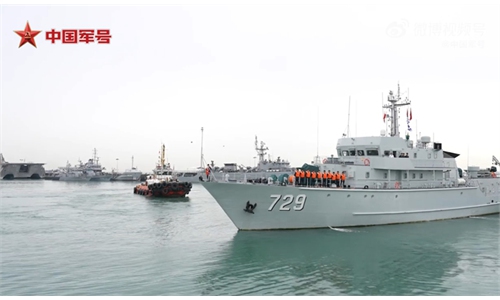
Compared with previous exercises, China did not deploy minesweeper vessels this time. Zhang Junshe, a military affairs expert, told the Global Times on Sunday that the selection of participating vessels is determined through joint consultation based on factors including military requirements, training plans and logistical support, and is aligned with the exercise objectives and subject design. This year's exercise seems to be aimed at enhancing both sides' coordination capabilities in joint maritime operations and emergency response.
Regarding the announced drills, Zhang said that joint search and rescue is a regular component of the China-Singapore maritime exercises. This subject holds significant practical importance. The South China Sea is a critical international shipping artery where sea lanes converge and maritime traffic is dense. The area's complex hydrometeorological conditions make natural disasters and maritime emergencies a recurring reality.
Under the search and rescue responsibility zones designated by the International Maritime Organization, both China and Singapore have maritime rescue obligations in relevant areas of the South China Sea, and their naval forces accordingly bear these responsibilities, Zhang said.
"Both sides are focused on jointly addressing traditional and non-traditional maritime security threats, demonstrating the two navies' practical cooperation and sense of responsibility in maintaining regional peace and stability," he said.
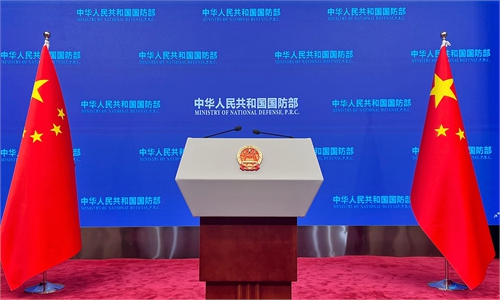
The Ministry of National Defense said on Thursday that the exercise includes live-fire shooting drills. Zhang said live-fire and replenishment drills focus on enhancing each navy's operational capabilities: live-fire shooting helps vessels hone their actual weapons employment skills, while underway replenishment tests and improves sustained support capabilities for far-sea operations.
Zhang said the exercise carries threefold significance. First, it deepens mutual trust and cooperation. Joint exercises are a tangible expression of the two militaries' efforts to enhance mutual understanding, consolidate traditional friendship and build strategic trust.
Second, it improves joint response capabilities. The exercises help strengthen the two sides' practical ability to jointly address maritime security challenges and maintain regional peace and stability.
Third, it contributes to regional peace and stability. The exercise adheres to the principles of openness and transparency, and is clearly not directed at any third party. In the current complex regional environment, dialogue and cooperation are more beneficial than confrontation and suspicion, while coordination and mutual support are more reliable than acting alone. Military cooperation based on mutual trust serves as a constructive force for regional stability and global security governance.
The China-Singapore maritime exercise has become an influential bilateral program in the region. It provides a useful example for regional security architecture, helping increase dialogue opportunities, reduce confrontation, lower the risk of maritime miscalculation and promote regional security cooperation, the expert said.
RELATED ARTICLES