Xi to attend BRICS Summit in New Delhi, first India visit in 7 years
India-China co-op within BRICS serves broader interests: Indian scholar
By Xie Wenting, Zhang Yiyi, Xian Yifan in New Delhi, in Beijing Published: Sep 11, 2026 12:31 AM

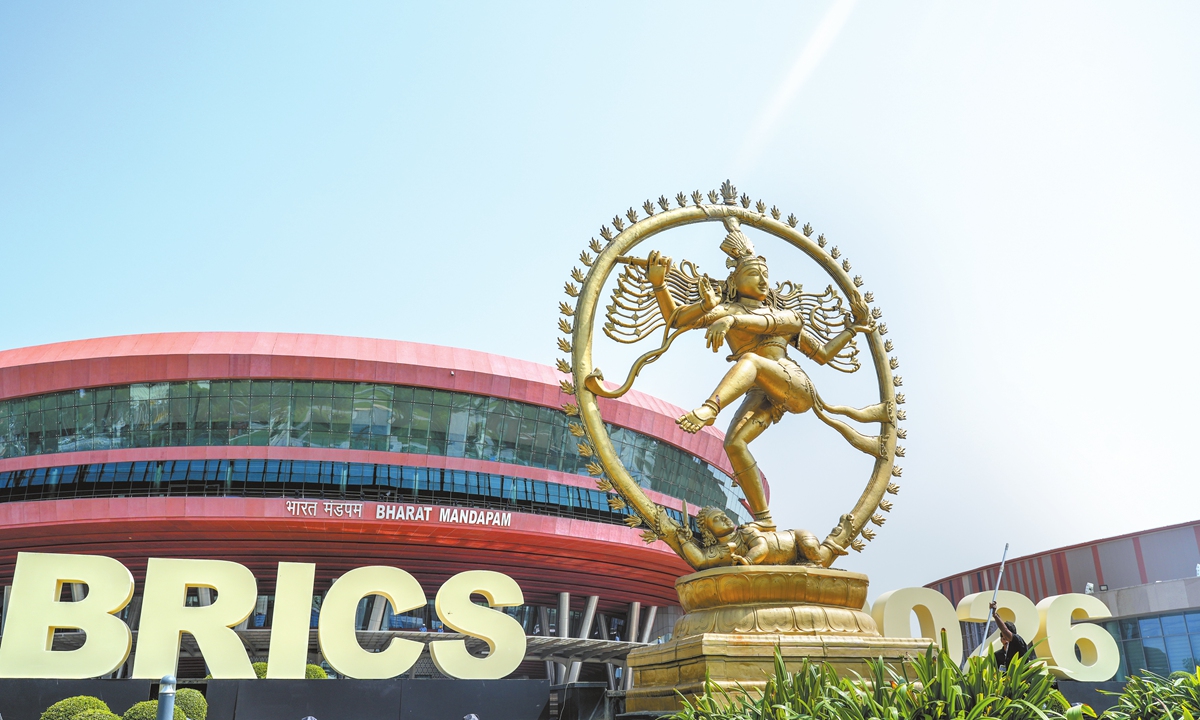
A worker is decorating the sign for the 18th BRICS Summit showcased at Bharat Mandapam, New Delhi, India on September 10, 2026. Photo: Xian Yifan/GT
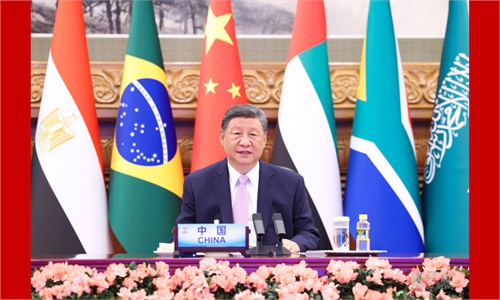
Chinese President Xi Jinping will attend the 18th BRICS Summit in New Delhi from Saturday to Sunday at the invitation of Indian Prime Minister Narendra Modi, a Chinese Foreign Ministry spokesperson announced on Thursday.
This highly anticipated visit will be President Xi's first visit to India in seven years, and it has drawn considerable attention, with Indian media outlets reporting on the announcement as soon as it was made.
"The Chinese President's visit to India is expected to be a high-profile diplomatic engagement. It will have implications for the ongoing efforts to stabilise bilateral ties between the two Asian powers," The Indian Express reported on Thursday.
Some Chinese and Indian experts reached by the Global Times view the visit as a significant opportunity to further improve bilateral ties, especially for India, as it is recalibrating its foreign policy priorities amid evolving global dynamics.
Mohammed Saqib, CEO of the Indian think tank Bureau of Research on Industry & Economic Fundamentals and the India China Economic & Cultural Council, told the Global Times that the Chinese President's upcoming visit has significantly raised the importance of the BRICS Summit.
"In the context of the warming of China-India relations, this visit will further promote the improvement and development of China-India relations," Qian Feng, director of the Research Department at Tsinghua University's National Strategy Institute, told the Global Times on Thursday.
Window for further progress
New Delhi is now entering BRICS Summit time. On the streets of New Delhi, which will host the summit, Global Times reporters noticed that posters and banners for the upcoming summit already line major roads and markets. Meanwhile, heightened security is visible in the capital. Some locals told the Global Times that India attached great importance to the summit and paid attention to the preparation work in the city.
When Global Times reporters visited the summit venue, Bharat Mandapam, on Thursday morning, many workers were busy decorating the site and surrounding areas as final preparations intensified.
Qian noted that India views the Chinese leader's visit as a very good opportunity to push for better ties. Bilateral meetings between the two leaders are expected during the visit.
The recent 25th Round of Talks Between the Special Representatives of China and India on the Boundary Question, held in Beijing on August 25, produced an 8-point consensus that both sides have described as a positive signal of improving relations. According to Qian, this outcome is evidence of recent progress. Further advances in the relationship would be "icing on the cake," he said.
Shubhajit Roy, senior diplomatic editor with The Indian Express, told the Global Times on Thursday that Xi's visit is "very significant." The broad areas of attention would include strategic, political, economic, and people-to-people ties.
People are expecting a "positive outcome" between China and India during the summit, Saqib noted.
The Indian expert highlighted strong complementarities between the two countries: China possesses strong hardware capabilities, while India has strengths in software and a large pool of young talent.
He stressed that India-China cooperation is important not only for bilateral relations but also for the Global South and the world as a whole. "If the two countries work together, the impact will extend far beyond their bilateral relationship."
India's economy is expanding, with GDP growth projected at around 6.8 percent for FY2025-26 and bilateral goods trade with China reaching about $151 billion in FY 2025-26, making China India's largest trading partner.
Saqib said recent developments show India has become more conscious of the need to recalibrate its foreign policy priorities. There was an assumption among some in India that closer relations with the US would automatically support India's development and that Washington would stand firmly by New Delhi. In practice, the US acts according to its own interests, Saqib added.
"China is India's neighbor. The two countries share ancient civilizations and, in many ways, understand each other better. There are also deep historical and cultural connections," Saqib said.
Roy noted that rebuilding trust remains "a work in progress" and "will not happen overnight," but multilateral platforms such as BRICS provide opportunities for both sides to better understand and respond to each other's concerns.
"If there is a climate of trust, a climate of economic cooperation, it will mean a better relationship between the two countries," he said.
Global South platform
Xi's attendance carries wider significance for BRICS as a platform for Global South cooperation, multipolarity, and the reform of global governance.
Qian highlighted several areas likely to draw attention. Financial cooperation, including local currency settlement and cross-border digital payments, is expected to be a major focus, with India as host positioned to advance practical steps.
After expansion, BRICS has become a larger grouping. Whether the summit can form consensus on membership issues while safeguarding the mechanism's unity and maintaining the priority of economic cooperation will be critical to its future role as a more effective pillar of global governance, Qian said.
On the streets of New Delhi, Global Times reporters saw many posters and banners carrying the BRICS slogan "Building for Resilience, Innovation, Cooperation and Sustainability," the theme of India's 2026 Chairship.
Other topics in the focus include adjustments to the voice of multilateral financial institutions, expansion of the New Development Bank's business and coverage, energy and clean energy transition, green finance, and collective responses to climate change. Issues such as artificial intelligence governance and food security may also see efforts to form common positions, according to experts.
On BRICS specifically, Saqib noted that on most items on the agenda, the interests of India and China are aligned, citing development in the Global South and reform of institutions such as the IMF and World Bank. He underscored that India-China cooperation within BRICS serves broader interests.
Roy pointed out that many Global South countries are looking to India and China to amplify their voice on concerns such as energy shortages, rising prices, and economic hardships faced by developing countries.
China's high-level participation sends a clear signal of continued commitment to the grouping's evolving role in promoting more inclusive global governance and practical cooperation among emerging economies, he said.
As the countdown continues, the venue is nearly ready, and the streets of the capital already bear the marks of the occasion. As the host city gears up, the gathering is set to underscore the grouping's role in advancing practical cooperation for a more inclusive and multipolar world.
RELATED ARTICLES