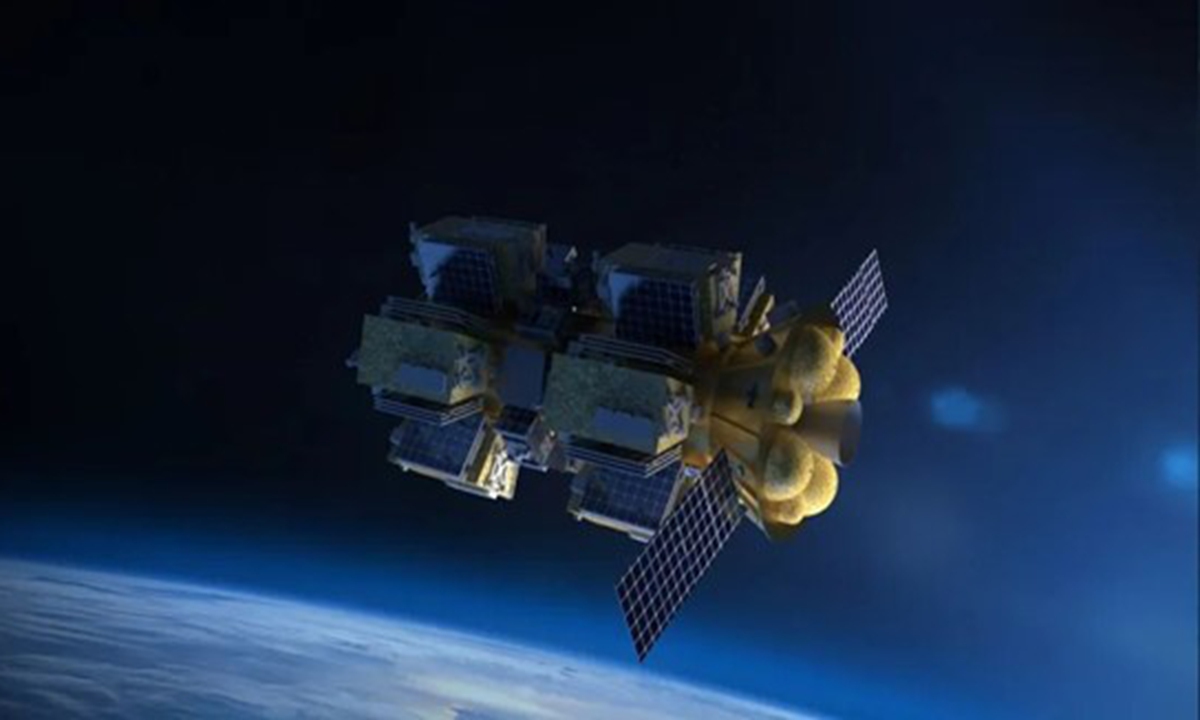
A simulation of Aishenxing-1 01 orbital platform developed by Chinese private space company Galactic Energy. Photo: Courtesy of Galactic Energy
China ranks second in the construction of global space infrastructure, according to a report released at the 2026 China International Fair for Trade in Services in Beijing over the weekend. The US is in the leading position, the report said.
The report, titled 2026 Global Space Infrastructure Assessment, evaluates space infrastructure oriented toward interstellar connectivity across 48 economies, using both hardware and software indicators that include life-support systems, launch and transport systems, communications, energy, laws and regulations, and dispute settlement mechanisms.
The other economies listed in the top 10 are Japan, Russia, the United Kingdom, Germany, France, India, Italy and the Netherlands.
In terms of space-related hard power, the US and China lead, while Russia, Japan, the UK and India are competitive. In terms of soft power, France, the US, China, Russia, and Italy are among the leaders, according to the report.
The report also projected that human space activity will remain concentrated in cislunar space until 2035. After 2040, the development of Earth-Mars space may become feasible, but large-scale access to interplanetary space is unlikely in the near term. Outer space will become a new arena of geopolitical and technological competition, it said.
Wang Peng, an associate research fellow at the Beijing Academy of Social Sciences, told the Global Times on Sunday that though the space industry as a whole remains in the early stage of large-scale constellation deployment, competition in the sector will become more intense in the next decade.
"It is highly likely that cislunar space will become the principal arena of global space competition, with the focus of competition shifting from a contest of individual technologies to competition over ecosystems and the power to set rules. The leading economies will likely dominate the arena, and other countries and regions could pursue differentiated paths in some specialized segments of space," Wang noted.
In terms of space infrastructure, industry watchers said that China has a competitive edge in crewed space operations and on-orbit stay in the low-Earth orbit, a systematic navigation and Earth-observation architecture, as well as the organizational capacity to deliver major programs. China is also rapidly catching up in other fields, such as reusable launch vehicles, which could pave the way for more low-cost commercial deployment.
"The development of space infrastructure will be deeply integrated into the terrestrial digital economy and closely combined with next-generation communications technology. It will become a core strategic foundation for the future digital economy and lay the groundwork for the systematic development of deep-space exploration," Wang added.
The space report was jointly released by the Institute for Global Cooperation and Understanding of Peking University, the Institute of Urban Internationalization Studies of Zhejiang International Studies University, the Center for Science and Technology Development and Governance of Tsinghua University, and the School of Public Policy of The Chinese University of Hong Kong, Shenzhen, among other institutions.
Global Times
RELATED ARTICLES