Intensive head-of-state diplomacy boosts China's global partnership drive
Multidirectional diplomacy bolsters Global South cooperation, injects fresh momentum

Top News
Chinese President Xi Jinping's diplomatic tour across Central Asia, the Middle East and South Asia highlights a multidimensional foreign policy strategy focused on strengthening bonds with neighbors and the Global South, Chinese analysts said. The flurry of high-level engagements has injected fresh momentum into China's push for global partnerships, charting a clearer and more determined course for its diplomacy.
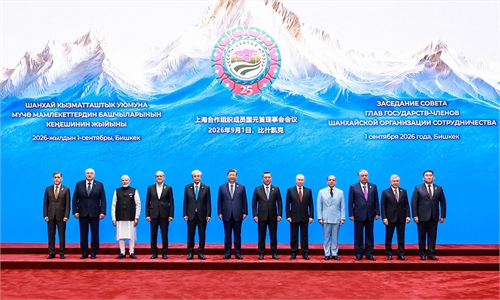
From August 30 to September 3, President Xi attended the Shanghai Cooperation Organization (SCO) Summit 2026 in Bishkek and paid state visits to Kyrgyzstan and Egypt. He then traveled to New Delhi for the 18th BRICS Summit from September 12 to 13, according to the Xinhua News Agency.
The latest wave of head-of-state diplomacy highlights a strategy of strengthening ties with neighboring countries, deepening Global South cooperation through the SCO and BRICS platforms, and reinforcing relations with long-standing partners such as Egypt. The image of China as a stable partner, however, is less a product of US-China competition than the result of Beijing's long-standing diplomatic approach and expanding partnership network, said Chinese analysts.
Focus on cooperation
This round of busy diplomacy has unfolded across different regions with distinct priorities, while sharing a broader emphasis on bilateral and regional cooperation and ties with the Global South, said analysts.
The visit to the Central Asian nation came as China-Kyrgyzstan cooperation has ushered in a "golden period" of rapid development, as noted by President Xi in a written speech delivered upon his arrival, with the two countries working to translate their longstanding friendship and strong political mutual trust into broader cooperation and greater benefits for their people, according to Xinhua.
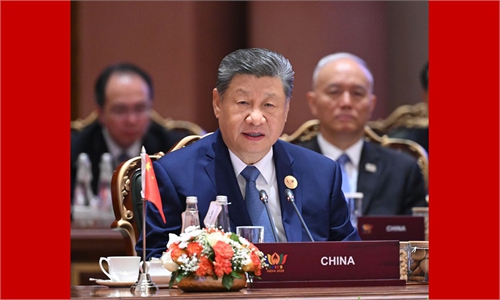
When attending the SCO summit in the Kyrgyz capital of Bishkek, Xi called on countries to "stay committed to putting development first, and open up the prospects for shared prosperity."
The SCO "takes root in the Global South, its heart beats with the Global South, and it is an important pillar of South-South cooperation," Xi said, calling on the SCO to "promote the development and rise of the Global South through the SCO Wisdom."
While in Egypt, President Xi had talks with Egyptian President Abdel Fattah El-Sisi, emphasizing China's support for regional countries in building a new security architecture in the Middle East via upholding a vision of common, comprehensive, cooperative and sustainable security.
The two heads of state also jointly witnessed the signing of multiple cooperation documents on Belt and Road cooperation, artificial intelligence, economic and trade, and industrial and supply chain cooperation.
In New Delhi, President Xi and Indian Prime Minister Narendra Modi conducted a candid and in-depth exchange of views, and reached important consensus that China and India should be partners.
In a speech when attending the BRICS summit, Xi called on BRICS countries to strengthen unity among the Global South and play an active, stabilizing and positive role in global affairs and also outlined concrete proposals to further strengthen greater BRICS cooperation, with a focus on emerging areas including artificial intelligence, trade, digital industries and manufacturing.
The Kyrgyzstan visit underscored China's focus on neighborhood diplomacy and the SCO as a key platform for regional political, security and economic cooperation. In Egypt, the emphasis was on consolidating ties with a long-standing partner and coordinating efforts on Middle East peace and stability. The India leg highlighted BRICS and broader Global South cooperation, while also advancing China-India communication, Qian Feng, director of the Research Department at Tsinghua University's National Strategy Institute, told the Global Times.
Taken together, the visits reflect a multidirectional approach that strengthens neighborhood ties, deepens Global South cooperation and consolidates relations with traditional partners through bilateral and multilateral channels, said Qian.
Yang Xiyu, a senior research fellow at the China Institute of International Studies, said this round of intensive head-of-state diplomacy serves both domestic development and broader strategic goals.
As China enters a crucial stage of the 15th Five-Year Plan, it demonstrates the country's commitment to high-standard opening-up, expanding global partnerships and advancing major initiatives. Additionally, it responds to growing international instability. Amid persistent conflicts, rising unilateralism and mounting geopolitical and economic tensions, China is using platforms such as the SCO, China-Central Asia cooperation and BRICS to promote strategic stability and strengthen coordination among developing countries, said Yang.
"By deepening cooperation with the Global South and expanding multilateral engagement, China seeks to create a more stable external environment for its own development while contributing to peace, stability and sustainable growth worldwide," said the expert.
A stable-partner image
During his talks with Egyptian President Abdel Fattah El-Sisi, Xi raised a four-point proposal on building a new security architecture in the Middle East, saying that China supports countries in the region in developing good-neighborly and friendly relations.
During the Bishkek SCO summit, Xi put forward a four-point proposal, calling on the SCO to stay committed to putting development and the people first, taking security as a key goal, and promoting dialogue and consultation.
While in New Delhi at the BRICS summit, President Xi proposed five initiatives on "greater BRICS" cooperation in areas of AI, trade and investment facilitation, digital industry, smart manufacturing, and talent development.
These proposals and initiatives embody China's wisdom and solutions to the complex challenges facing global governance. By building broader consensus among Global South countries, China contributes to amplifying their collective voice and strengthening coordination against unilateralism, protectionism and power politics, said Yang.
Regarding Xi's four-point proposal on building a new security architecture in the Middle East, the Egyptian media outlet Ahram Online published an article noting that, although China's initiative was unveiled in Cairo, its significance extends well beyond Egypt-China relations. It opens the possibility of a different system: a multilayered architecture combining deterrence with development, and regional responsibility with international support.
However, the concentration of China's overseas engagements has also drawn skepticism from some Western media outlets, with the Washington Post describing the itinerary as a "rare flurry of trips" and claiming that China is seeking to present itself as a "stable partner," especially for developing countries, "during a period of what Beijing has portrayed as US-driven geopolitical uncertainty."
Some Western media outlets also portray China's recent diplomacy as an attempt to build an alternative to the US, reflecting a traditional great-power rivalry lens. Such misinterpretations overlook the continuity of China's foreign policy, said Qian, noting that China's outreach is not an ad hoc response to China-US interactions.
From strengthening ties with neighboring countries and advancing SCO and BRICS cooperation to coordinating with Egypt on regional peace and security, these efforts reflect China's long-standing diplomatic approach, said Qian.
China has no intention of replacing the US, said Qian, adding that its diplomacy is aimed at widening cooperation, strengthening multilateralism and promoting political solutions to conflicts.
That approach also serves China's own need for a stable international environment. Its image as a "stable partner" is the result of sustained engagement, not an attempt to build an anti-US alternative, Qian noted, adding that reducing China's diplomacy to great-power rivalry misses its role in supporting development, cooperation and stability.
RELATED ARTICLES