BUSINESS / PRESS RELEASE
Foreign engineers heatedly discuss China’s green building wisdom
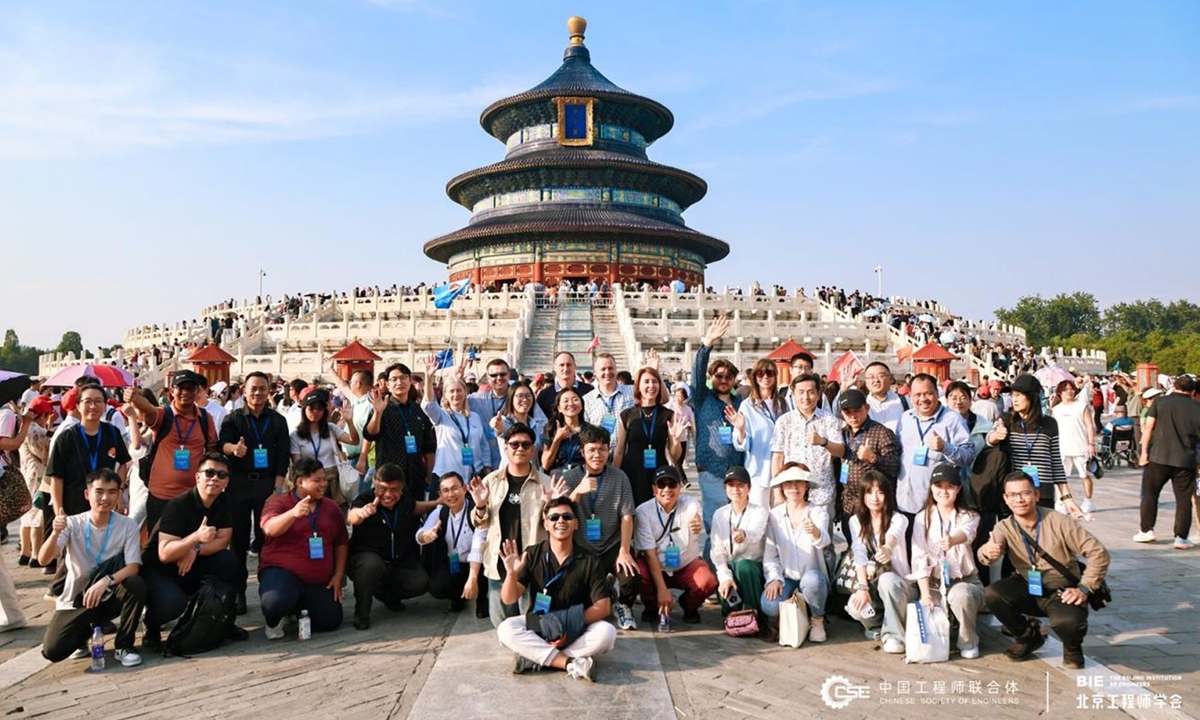
Engineers visit the Temple of Heaven during the 2026 Engineering Capacity Building Program (Green Building) on September 16, 2026. Photo: Courtesy of Chinese Society of Engineers
The 2026 Engineering Capacity Building Program (Green Building) has concluded successfully in Beijing. Through keynote presentations, technical workshops, on-site field visits and thematic exchanges, Chinese and foreign engineers conducted in-depth discussions on green building technologies and practices. They explored the passive low-carbon design wisdom embodied in traditional Chinese architecture, advancing in-depth technological mutual learning and inclusive cross-cultural integration.
The core of China's green worldview is "harmonious coexistence" - the harmonious unity between humanity and nature, tradition and innovation, city and region, engineering and society, Wu Jiming, supervisor of the Science and Technology Quality Center of the Beijing Institute of Architectural Design Co., Ltd. (BIAD), said in a keynote presentation during the engineers' visit to BIAD on the morning of September 15.
This worldview emphasizes "harmony in diversity," respecting differences and co-creating; emphasizes "the unity of knowledge and action," translating ideas into engineering practice; and emphasizes "co-building and sharing," using engineering science and technology as a universal language to enable Chinese engineers to engage more deeply in global governance and share China's experience and practical wisdom, Wu said.
Alan Poon, a representative from the Institution of Engineers Malaysia, highlighted three uniquely valuable strengths of China's green building development: large-scale implementation, rapid iterative upgrading, and multi-dimensional technological integration.
"China's capability to integrate engineering design, advanced manufacturing, prefabricated construction, digital building technology and infrastructure delivery is truly impressive," Poon told the Global Times. "Malaysia should learn from this mature development model rather than simply copying it. Beijing and Kuala Lumpur differ greatly in climate conditions, energy systems and urban construction contexts, so we must tailor advanced technologies to local scenarios," he said.
Poon noted, "Implementation is the common core challenge we are facing globally. Mature green building technologies are already available, while the real difficulties lie in financing mechanisms, standard unification, existing building renovation, talent cultivation, data interoperability and verifying practical operational performance. I always believe that the next revolution in green building is not about developing more new technologies, but integrating existing mature technologies and delivering measurable low-carbon outcomes."
When asked whether traditional Chinese architectural philosophies have reshaped and enriched his understanding of green and low-carbon architecture after visiting the Temple of Heaven, Poon gave a positive answer without hesitation, calling the inherent connection between ancient wisdom and modern low-carbon development "fascinating."
Poon noted that Malaysia also has its own distinctive traditional architectural wisdom. "Malaysian vernacular buildings adapt to hot and humid tropical climates through rational shading design, natural ventilation systems, elevated structures, extended eaves and eco-friendly local materials. Chinese traditional architecture evolved under different climatic and geographical conditions, yet it shares the same core logic: prioritizing adaptation to local climate and nature, rather than relying purely on mechanical systems to offset environmental shortcomings."
"The integration of ancient architectural wisdom with modern simulation technology, high-performance building materials, renewable energy systems, sensors, AI and digital twin technology will chart a promising path for future ASEAN-China academic and engineering cooperation. It combines time-tested traditional concepts, cutting-edge modern engineering and quantifiable low-carbon performance," Poon said.
Kostarev Maksim, president of the CCI Union of the Tomsk Region, pointed out that China's experience in green and smart construction offers valuable references for Russia's engineering industry.
China's systematic overall planning, standardized BIM modeling, refined digital monitoring and the integration of smart technologies into conventional building operations are particularly worthy of learning, Maksim told the Global Times. "It is advisable to adopt China's development mindset that incorporates energy efficiency design at the initial conceptual stage, rather than retrofitting energy-saving functions after construction completion."
Maksim added that the visit to the Temple of Heaven refreshed his understanding of sustainable architecture, proving that low-carbon and sustainable development is never solely dependent on high-end technologies. "Traditional Chinese architecture embodies profound insights into building orientation, natural lighting, airflow optimization, material selection and the harmonious interaction between architecture and the ecological environment. Admittedly, ancient buildings cannot be directly compared with modern architectures in terms of contemporary energy efficiency standards, but their core principles of rationally utilizing climate conditions, spatial resources and building materials remain highly applicable today."
He emphasized that traditional Chinese architectural wisdom provides innovative solutions for Russia's low-carbon construction development. "The most valuable takeaway is that low-carbon construction requires the organic integration of modern technologies and time-tested traditional architectural principles - a development model that China is fully practicing and promoting."
