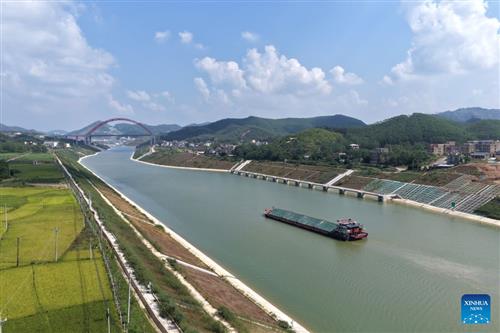
If a ton of cargo travels hundreds of kilometers less, what does it mean for China-Indonesia trade?
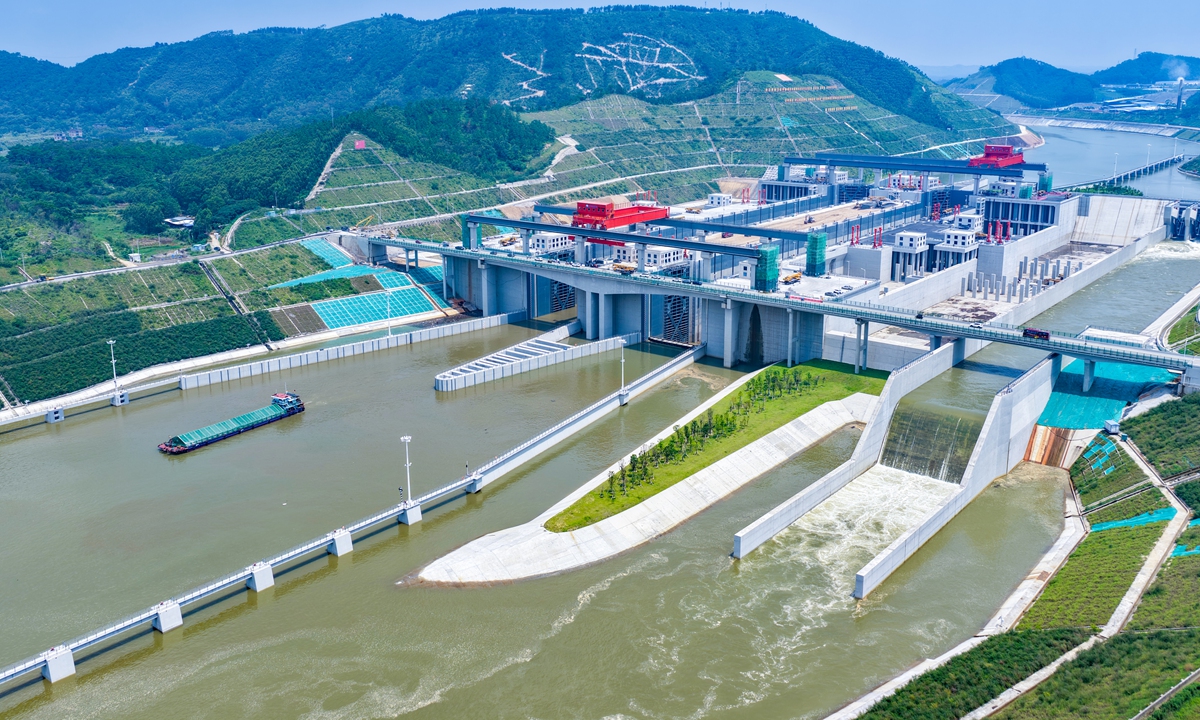
A vessel sails along the Pinglu Canal near the Madao hub. Photo: Courtesy of Pinglu Canal Group
At the Pinglu Canal exhibition area at the 23rd China-ASEAN Expo in Nanning, South China's Guangxi Zhuang Autonomous Region, in late September, an Indonesian student studying in China lingered in front of the Pinglu Canal display.
For most visitors at the exhibition, the Pinglu Canal is a 134.2-kilometer-long project connecting the Xijiang River with the Beibu Gulf. Yet for Alvin Candra Andrianto, the Indonesian student standing in front of the exhibition panel, what he saw extended beyond figures, hubs and water channels. He told Chinese media that his thoughts turned first to his country, an archipelago of tens of thousands of scattered islands, where vessels form the fundamental lifeline for moving supplies and connecting communities.
This Indonesian student recognized the core significance of the Pinglu Canal: at its heart, a century project is about using an artificial waterway to overcome geographical barriers - moving goods faster, making business easier, and making cooperation more tangible. Andrianto expressed hope that the Pinglu Canal will further enrich the logistics network connecting China and Indonesia and reduce the cost of bilateral trade.
When I discussed the Pinglu Canal with Indonesian scholar Humprey Arnaldo Russel, head of ASEAN-China Research Cluster of Department of Global Studies at the Graduate School of Sustainable Development Universitas Indonesia, he spoke enthusiastically about some of his Indonesian students who had developed a keen interest after learning about the Pinglu Canal. Raised amid archipelagos and familiar with maritime shipping, these young Indonesian students offer a more grounded perspective. They see the canal as a way to move goods more smoothly and reduce transport costs while wondering how such a passage can help their country's products reach the Chinese market. Infrastructure is far more than digging river channels and building docks; connectivity creates possibilities for development.
Without the Pinglu Canal, goods from China's inland southwest bound for Indonesia had to travel east along the Xijiang River and detour around the Pearl River Delta, adding over 560 kilometers to inland navigation routes. The longer voyage meant more transit time and higher freight costs.
If a ton of cargo travels hundreds of kilometers less, what does it actually mean?
Take frozen durian entering the markets of Southwest China as an example. To Chinese consumers, frozen durian from Indonesia is a distinctive imported delicacy, bringing a taste of Indonesia to their tables. However, within the cross-border cold chain logistics network, its journey is a race against time. The fruit is harvested on plantations in Sumatra or Java in Indonesia, flash-frozen and packed, before beginning its long journey to households across China. Time is the lifeline for fresh produce. Every extra day of transit brings a greater risk of spoilage and higher logistics expenses.
According to official data, the Pinglu Canal will enable goods from Southwest China to reach Qinzhou Port on the Beibu Gulf directly, before heading on to Indonesia, cutting overall logistics costs by an estimated 18 to 30 percent and saving more than 5 billion yuan (about $740 million) in transportation costs each year. Goods coming from ASEAN countries will also benefit from lower logistics costs.
International relations are often described in grand terms: trade volumes, investment figures and strategic partnerships. For countless small and medium-sized traders, cross-border cooperation begins with a freight quote. One of the Pinglu Canal's key values lies in translating the grand vision of state-to-state connectivity into tangible, calculable benefits for enterprises.
The Guangxi Jingui Pulp & Paper project, invested in by Indonesia's Asia Pulp & Paper Group in Qinzhou, serves as a vivid example. The enterprise imports wood chips and pulp from Indonesia as raw materials, while finished paper products are exported to markets including Indonesia and other ASEAN countries. With transportation routed through the Pinglu Canal, logistics costs can be reduced in both directions. Such examples also address doubts raised by some foreign media outlets about whether the Pinglu Canal can deliver real results.
Looking back at that young Indonesian student gazing at the exhibition panel, one can see in the ships navigating the Pinglu Canal a vivid portrait of China-Indonesia and China-ASEAN cooperation. A canal in Southwest China helps young people from ASEAN understand China's vision for connectivity. As a core artery of the New International Land-Sea Trade Corridor, the Pinglu Canal opens not only a waterway linking rivers and the sea but also new opportunities for cooperation and development between Southwest China, Indonesia and the broader ASEAN region.
With falling logistics costs and lowered trade thresholds, more small and medium-sized businesses will emerge. The partnership between China and Indonesia, as well as China and ASEAN, will evolve into a deeper, long-standing pattern of industrial symbiosis through repeated voyages of cargo ships traveling back and forth for mutual benefit.
The author is a commentator of the Global Times. The article was first published in Jakarta Globe. suyaxuan@globaltimes.com.cn
RELATED ARTICLES