China creates the coldest man-made matter ever aboard the China Space Station
Matter cooled to just 9.7 trillionths of a kelvin above absolute zero opens up new possibilities for quantum research, researchers say
By Published: Nov 06, 2026 07:08 AM

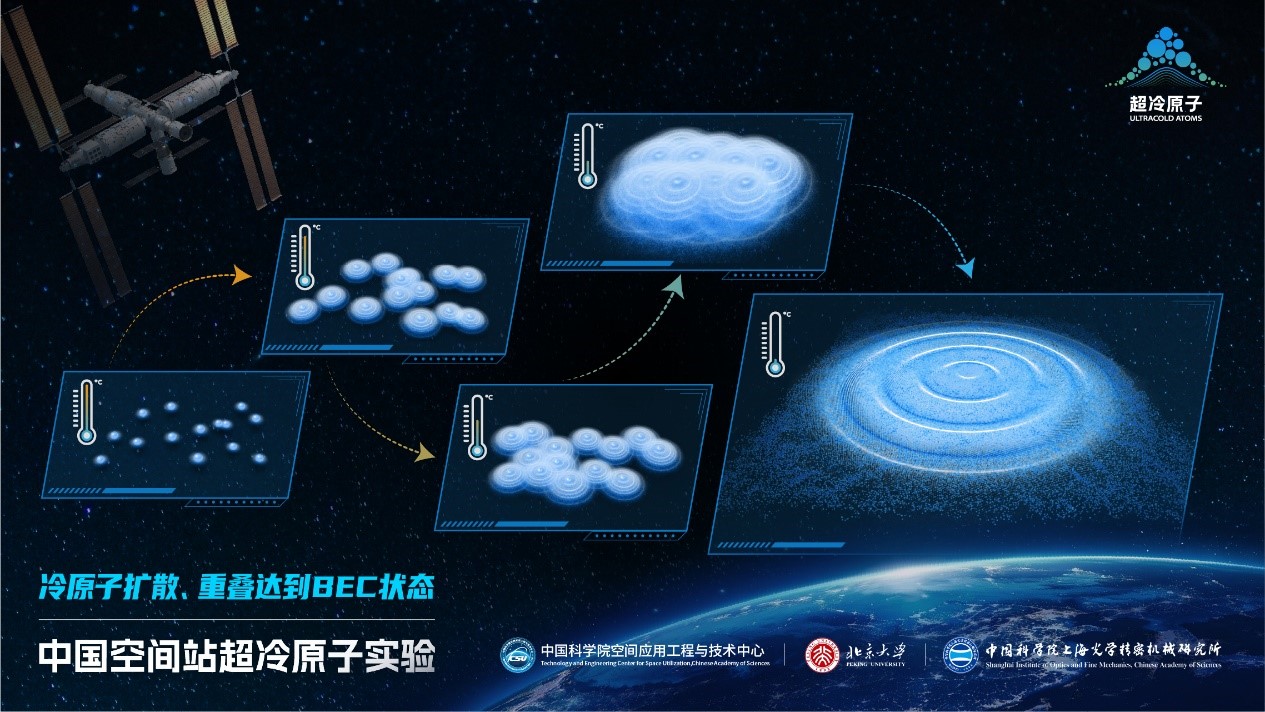
Illustration of the ultracold atom experiment aboard China Space Station. Photo: Courtesy of the Technology and Engineering Center for Space Utilization, Chinese Academy of Sciences (CAS)
Chinese scientists have successfully created the coldest man-made matter ever recorded aboard the China Space Station, cooling a cloud of rubidium atoms to just 9.7 trillionths of a degree above absolute zero – the lowest possible temperature in the universe – in a breakthrough that sets a new world record and opens fresh possibilities for exploring the mysteries of quantum physics and the universe, the Global Times learned from program insiders on Thursday.The achievement was announced by the Department of Space Science and Applications, Chinese Academy of Sciences (CAS) at a press conference on Thursday. It was achieved using an ultracold atomic physics experiment facility aboard the China Space Station. Scientists were able to observe the ultracold atomic cloud for seven seconds, providing an unprecedented opportunity to study the behavior of matter under extreme conditions.
The findings are scheduled to be published online in the international scientific journal Science on November 6, in a paper titled “Quantum gases below 10 picokelvin in space.”
The experiment lowered the equivalent temperature of the rubidium atomic cloud to 9.7 picokelvin (pK), or 0.0000000000097 kelvin, approximately 14 orders of magnitude lower than room temperature.
For comparison, the previous record was 38 pK, according to the CAS department, achieved by researchers at the University of Bremen in Germany in 2021 using a microgravity environment in a drop tower. In 2022, NASA’s Cold Atom Laboratory aboard the International Space Station achieved an equivalent temperature of 52 pK.
Scientists explained that atoms can be thought of as tiny particles constantly moving in random directions. The higher their temperature, the faster they move. Cooling them slows their motion, allowing researchers to observe and control them with extraordinary precision.
Absolute zero, equivalent to minus 273.15 C, represents the theoretical lower limit of temperature. Although the laws of thermodynamics make reaching absolute zero impossible, scientists have spent more than a century developing techniques to approach it.
At extremely low temperatures, atoms can begin behaving collectively according to the unusual rules of quantum mechanics, forming what is known as a Bose-Einstein condensate, according to the CAS.
Such states of matter provide scientists with powerful tools for investigating fundamental physical laws that are otherwise difficult to observe. But achieving these temperatures on Earth presents a major challenge: gravity.
Chen Xuzong, a professor at Peking University’s School of Electronics and a corresponding author of the study, told the Global Times on Thursday that atoms are typically confined within traps formed by magnetic or optical fields. During cooling, these traps must be gradually weakened, but Earth’s gravity limits how far the process can go.
In the microgravity environment of the China Space Station, scientists can weaken the traps much further without losing the atoms, allowing them to reach temperatures that would be extraordinarily difficult to achieve on Earth.
The resulting atomic cloud expands at an extremely slow speed of a just a few micrometers per second, giving researchers considerably more time to study its behavior.
According to the research team, ground-based experiments previously allowed observation periods of around 0.05 seconds, while experiments aboard the International Space Station achieved approximately one seconds.
China’s space station has extended that window to seven seconds, per the CAS.
The longer observation time could eventually improve the precision of atomic interferometers, instruments that use the wave-like behavior of atoms to make exceptionally sensitive measurements, by an order of magnitude, researchers said.
The achievement also demonstrates a distinctive technological approach developed by Chinese scientists.
While previous international experiments relied primarily on magnetic traps formed by atomic chips, the Chinese team adopted an all-optical trapping technique, using precisely controlled laser beams to capture and cool atoms.
The researchers combined evaporative cooling with a further cooling process that allows the atomic cloud to expand, ultimately reaching temperatures below 10 pK.
Although technically challenging, the optical approach is less sensitive to magnetic-field interference and offers greater flexibility for future quantum experiments, scientists explained.
The experiment was conducted inside the ultracold atomic physics facility aboard the Mengtian laboratory module, which was launched in 2022.
Developed under the leadership of the Shanghai Institute of Optics and Fine Mechanics, the system also represents a major engineering achievement.
Scientists miniaturized and integrated laboratory equipment that originally occupied a volume of 20 cubic meters and weighed approximately 10 tons into a compact experimental cabinet with a volume of just 0.7 cubic meters and a weight of around 500 kilograms.
The miniature laboratory operates automatically in orbit, integrating sophisticated lasers, optical instruments, vacuum systems and precision controls.
Wang Qiang, commander-in-chief of the space application system of China’s manned space program, said the project began its initial planning in 2011 and took 15 years of collaboration among scientific and engineering teams to achieve the breakthrough.
The research was jointly conducted by the Technology and Engineering Center for Space Utilization under CAS, Peking University and the Shanghai Institute of Optics and Fine Mechanics.
Beyond breaking a temperature record, the experiment could help scientists investigate some of the most fundamental questions about matter and the universe. At such extraordinarily low temperatures, researchers can manipulate atoms to simulate complex quantum systems, potentially shedding light on unusual states of matter, the behavior of particles and even questions related to dark matter.
Chen Weibiao, a researcher at the Shanghai Institute of Optics and Fine Mechanics, explained to the Global Times that the platform could support studies of quantum phase transitions, quantum many-body systems and fundamental physical theories.
In practical applications, ultracold atoms could enable more precise quantum sensors, atomic interferometers and space-based measurement systems, he said.
Such technologies may eventually improve navigation, measurements of Earth’s gravitational field, satellite orbit determination and monitoring of changes in glaciers and ocean currents, according to the CAS.
The breakthrough also underscores the growing role of China’s space station as a laboratory for fundamental scientific discoveries.
Lü Congmin, chief designer of the space application system of China’s manned space program, said the achievement demonstrated China’s advanced capabilities in ultracold atomic physics. He also extended an invitation to scientists worldwide to conduct research using the facility aboard China’s space station, pledging to share the experimental platform and scientific data.
