Manila’s potential bid for second South China Sea legal case ‘amounts to more hype over unfounded claims’
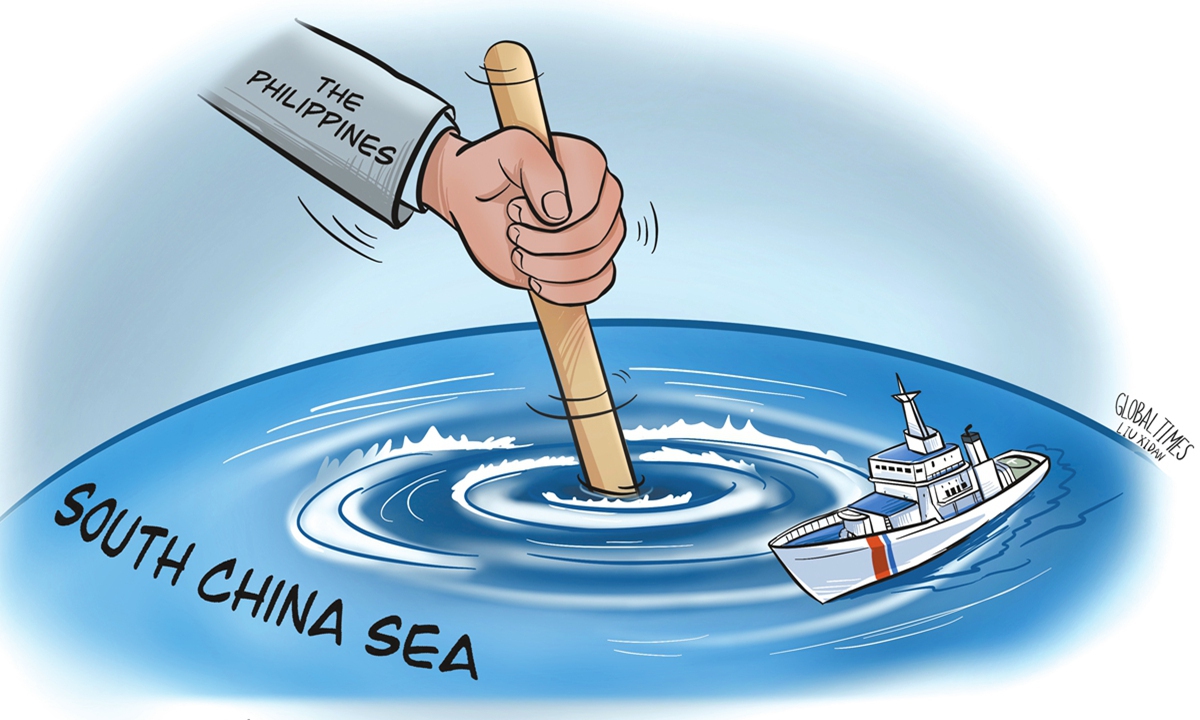
Philippines South China Sea Illustration: Liu Xidan/Global Times
A Philippines-based security analyst revealed that Manila is preparing for a potential second legal case against Beijing over the South China Sea, according to the South China Morning Post (SCMP) on Saturday.As of now, there has been no official announcement from the Philippine government regarding the confirmed details of the matter. The reported move amounts to more hype over unfounded claims, Chinese experts said, warning that if the move is implemented, the maritime situation could become even more unpredictable, further escalating tensions in the region.
Rommel Banlaoi, president of the Philippine Society for International Security Studies, said on Saturday at a South China Sea symposium in Sanya of South China's Hainan Province that the Philippines is considering filing another case against China, and authorities are already preparing the necessary legal documentation, according to SCMP.
The report cited Banlaoi as saying that any legal move would require Marcos' approval: "The president must give the green signal to do such a thing," and Manila was likely to hold off for now.
This year marks the 10th anniversary of the illegal "South China Sea arbitration award," which China has repeatedly emphasized its position that the award is nothing but a worthless piece of paper that is illegal, null and void, and has no binding force.
"The 'arbitration' violates fundamental principles of international law, including state consent and pacta sunt servanda, contravenes UNCLOS itself, and, still more importantly, runs counter to the basic facts of the South China Sea," Chinese Foreign Ministry wrote in a statement on July 12 responding to certain countries' playing up of the award 10 years after its issuance.
For the past 10 years, the "award" has not only failed to resolve the maritime issues between China and the Philippines, but instead has become a tool for the Philippines to expand its territorial and maritime claims, exacerbated tensions in the region and provided a pretext for external forces to intervene and destabilize the South China Sea, the statement said.
According to a previous report by Philstar.com in 2024, retired Supreme Court senior associate justice Antonio Carpio had once claimed that the Philippines should file another arbitration case against China.
Potential push of certain Philippine forces for a new round of arbitration-related proceedings shows that it still intends on pursuing a unilateral "legal" approach and repeatedly hyping the issue, rather than genuinely seeking to resolve it, Yang Xiao, a research fellow at the Institute for Peace and Development of the Chinese Academy of Social Sciences, told the Global Times, highlighting that the move's primary aim appears to be creating publicity around the issue.
Banlaoi said the new case could involve seeking compensation for environmental destruction and economic losses, as well as addressing alleged violations of sovereign rights and other breaches of the UN Convention on the Law of the Sea. He said Manila was currently gathering and preserving evidence, per the media report.
As this is hardly a new topic, Yang said that China has made some progress in ecological and environmental protection in the region, which means the Philippines appears to have an agenda, but lacks solid grounds. Its allegations and claims are unfounded, and are therefore doomed to fail, the expert added.
The potential "second case" could be rather seen as an information warfare campaign, said Chen Xiangmiao, director of the World Navy Research Center at the National Institute for South China Sea Studies.
In the current "arbitration," the Philippines secured a so-called ruling in its favor and used it to exert public opinion pressure on China. Its approach is to use the legal means as a political and diplomatic tool rather than genuinely seek to clarify facts or determine rights, and its true aim is to exploit the legal process to shape public perceptions and pressure China, Chen said.
Also mentioning that Manila lacks the basis to advance such proceedings, Chen said this is more a battle over public opinion and perceptions than a viable legal action.
Yang said that if the Philippines continues down this destructive path, it will only compound its mistakes. The facts of the past decade are clear: the so-called South China Sea arbitration brought no peace, but instead caused disruption. "Pursuing this path further will only lead to more mistakes and will never bring greater peace, development and prosperity to the countries and peoples of the region," he added.
RELATED ARTICLES