From ‘Shenzhen speed’ to humanoid robots: What draws foreign visitors to China's tech hub during APEC?
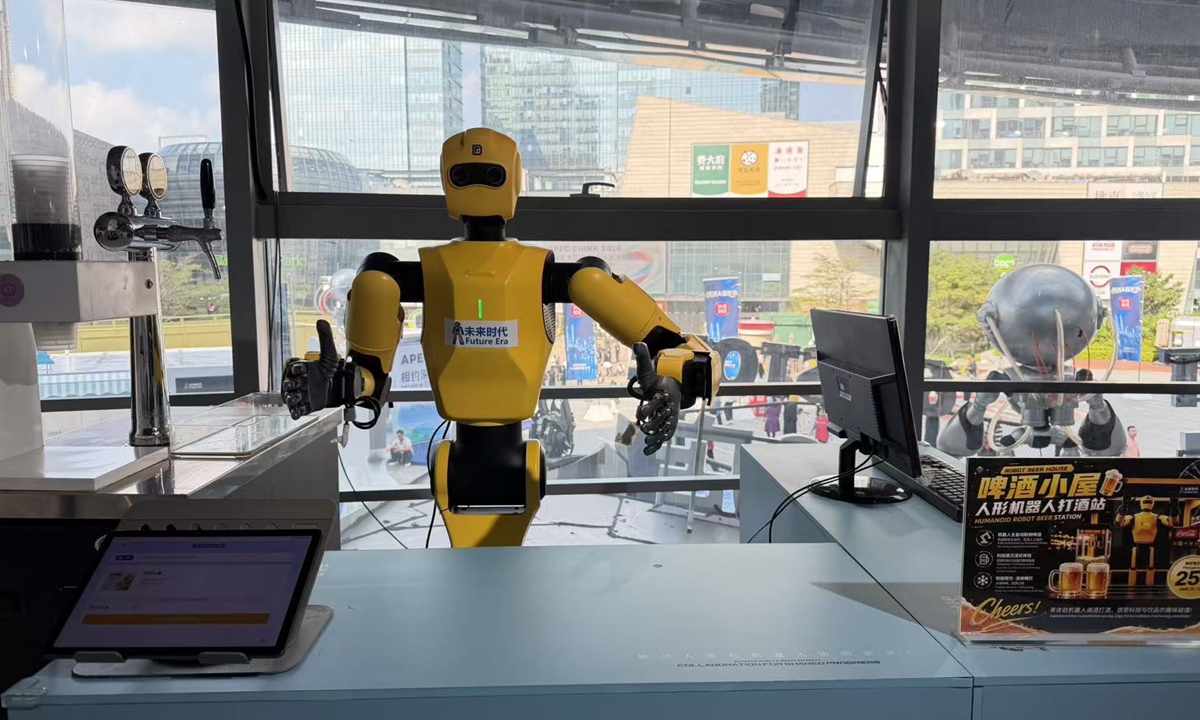
A humanoid robot makes coffee in Shenzhen, South China's Guangdong Province, on November 16. Photo: Ding Yazhi/ Global Times
What foreign visitors come to Shenzhen to see has changed over the past four decades. In the early years of China's reform and opening-up, they came to witness "Shenzhen speed," see factory assembly lines and learn how China's manufacturing sector operated. Later, their attention shifted to Huaqiangbei, the city's mega electronics marketplace. Today, a new attraction has joined their sightseeing lists: AI 6S stores, robot 6S stores, robot-themed streets and a glimpse of how artificial intelligence (AI) is becoming part of everyday life.
During the APEC meetings, the Global Times reporters visited the robot avenue beneath the Galaxy Twin Towers in Shenzhen's Longgang district on Monday, where a range of technologies are now on permanent display.
Coffee-making robots, AI-powered eyewear fitting pods, and robotic dogs capable of boxing are among the exhibits spread across more than a dozen robot-themed display units. The world's first robot 6S store and AI 6S store showcase more than 200 devices, around 30 percent of which are making their global debut or entering commercial application for the first time, a staff member told the Global Times.
The robot 6S store was bustling with visitors, about 70 percent of them foreigners. Lin Feng, the store manager, said visitors came not only from the Asia-Pacific region but also from around the world.
The growing international interest is reflected in a series of visits. In July, 38 foreign teachers from a university in Shenzhen visited the robot-themed area. A delegation of nearly 40 companies, including Morgan Stanley and the Spanish Friendship Association, also visited the AI 6S store, robot 6S store and robot theater.
Many foreign visitors want to understand what robots may be capable of in the future and how far the technology has already advanced, Lin said. They have described the robots as "so amazing" and "completely beyond my imagination."
On Tuesday during the APEC meeting week, organizers plan to attempt a Guinness World Record title, with 150 robots performing a continuous coordinated movement for one hour. The demonstration aims to showcase China's progress from small-batch robot production to mass manufacturing and coordinated control of large numbers of robots, Lin said.
For one Polish tourist visiting the venue, the experience offered a glimpse into the city's technological development. Having previously visited Macao, he said he chose Shenzhen because he wanted to experience a modern city.
The tourist said that it was ''worth it'' to see robots that behave like humans. He said he would recommend it to friends back home, summing it up in three words: "Impressive, modern, future."
Behind Longgang's growing robot-themed attractions is an industrial ecosystem supported by universities, research institutions and major technology companies. Products are tested in industrial settings before being brought into 6S stores and public spaces, allowing local residents and visitors to interact with, experience and purchase them, a person in charge of the robot-themed area told the Global Times.
Longgang is home to more than 13,000 AI and robotics companies, accounting for nearly one-fifth of Shenzhen's total. The district has also opened up 793 application scenarios under its "City + AI" initiative and established a 1-billion-yuan ($150 million) AI industry master fund, according to the avenue's official statement.
The model connects government efforts to open up real-world application scenarios with companies' technological capabilities, moving beyond simply attracting investment and projects to turning the city itself into a platform for AI development, the statement said.
Ding Ning from the Shenzhen Institute of Artificial Intelligence and Robotics for Society told the Global Times that this approach is consistent with the spirit of openness embodied in the APEC agenda.
The current wave of AI development requires not only advances in algorithms and computing power, but also progress across the entire industrial chain, including equipment, materials, core components and chips, Ding said. Relying solely on market forces could slow technological iteration and foster excessive competition in isolated sectors, while early institutional planning and coordination efforts can help ensure more orderly industrial development.
With its comprehensive industrial chain, diverse application scenarios and open cooperation policies, Longgang will promote cross-border technological exchanges, project implementation and two-way investment involving small and medium-sized enterprises. It will also leverage the APEC platform to deepen AI industrial cooperation across the Asia-Pacific region and jointly seize opportunities arising from the development of new quality productive forces, Ding said.
RELATED ARTICLES