China expects Dutch FM’s visit to boost mutual trust, cooperation as expert urges Netherlands to address Nexperia dispute
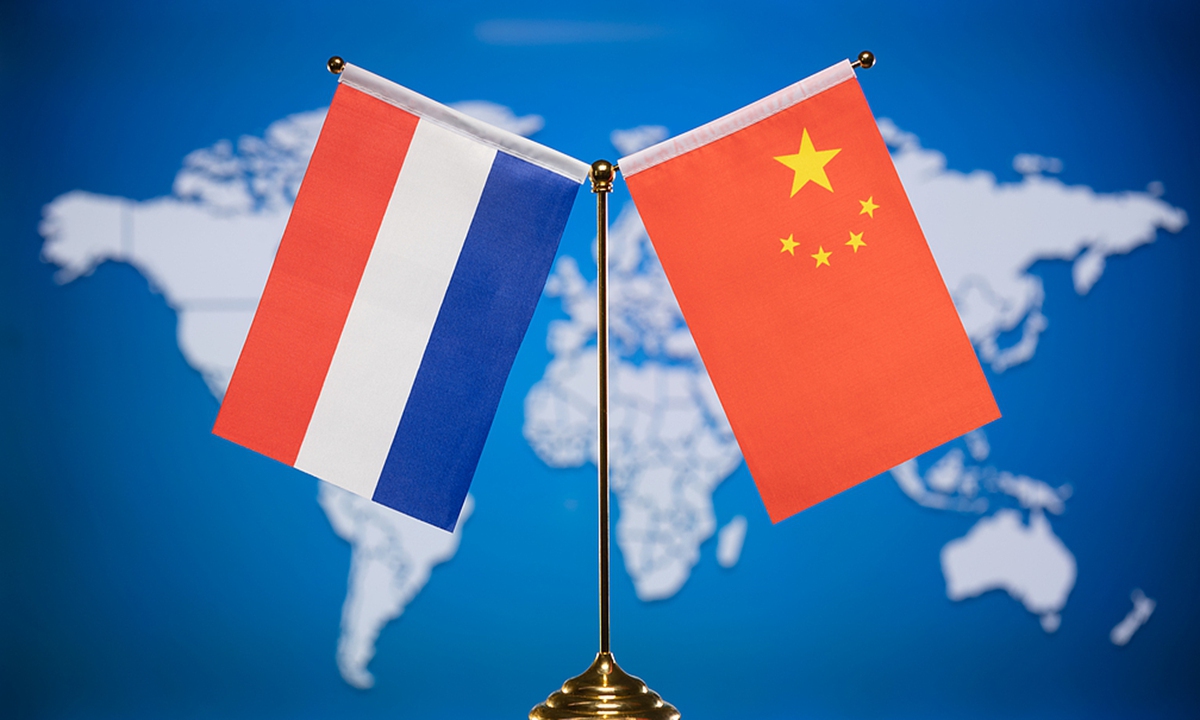
China, Netherlands Photo: VCG
China looks forward to conducting in-depth exchanges with the Netherlands on bilateral relations and international and regional issues of common concern during Dutch Foreign Minister Tom Berendsen's visit to China from Monday to Wednesday, with a view to enhancing mutual understanding and trust, promoting cooperation across various fields, and advancing sustained, sound and steady development of the open and pragmatic partnership for comprehensive cooperation for greater benefit to both peoples, Chinese Foreign Ministry spokesperson Guo Jiakun said on Monday.
The visit offers the Netherlands an important opportunity to strengthen communication with China, its important trading partner, and address differences through dialogue, particularly amid continuing tensions surrounding the semiconductor sector, a Chinese expert said. The Dutch side should value this window for engagement and avoid allowing certain disputes to undermine the broader bilateral relationship, the expert said.
Speaking at the regular press conference on Monday, Guo said that China and the Netherlands, both major economies in the world, are important cooperation partners.
Over recent years, under the strategic guidance of the two heads of state, the two countries have engaged in close high-level exchanges, made steady progress in practical cooperation in areas of agriculture, water conservation, environmental protection, and science and technology, and consistently deepened cultural and people-to-people exchanges, the spokesperson said.
The Dutch Embassy in Beijing shared details of the visit on its official WeChat account on Monday, mentioning that Berendsen will begin his trip in Shenzhen, South China's Guangdong Province, where he will visit innovative companies and meet with Dutch business leaders.
The visit carries significance beyond diplomatic exchanges, given the extensive economic and industrial ties between China and the Netherlands, Jian Junbo, director of the Center for China-Europe Relations at Fudan University, told the Global Times on Monday.
Jian noted that the official's visit provides the Netherlands with an important opportunity to strengthen communication with China, a major trading partner, and resolve differences through dialogue, particularly amid ongoing disputes in the semiconductor sector.
Recent exchanges have demonstrated that strengthening bilateral cooperation meets the needs of both sides.
On November 18, Chinese Ambassador to the Netherlands Shen Bo met Dutch Minister of Health, Welfare and Sports Sophie Hermans. The two sides exchanged views on China-Netherlands pragmatic cooperation on health and other related areas.
On November 5, China and the Netherlands held the ninth meeting of their export control dialogue mechanism in Shenzhen. The two sides discussed export control concerns and agreed to strengthen communication and jointly safeguard the stability of industrial and supply chains, including semiconductors.
However, the dispute surrounding Nexperia, a Netherlands-based semiconductor manufacturer owned by China's Wingtech Technology, remains a lingering issue in bilateral economic and trade relations.
On November 15, Bloomberg reported that Wingtech Technology said that it would appeal a Dutch court's latest interim order in the ongoing dispute over semiconductor manufacturer Nexperia, arguing that the ruling lacked a factual basis and contained fundamental legal flaws. Penalties for breaches of all the measures imposed by the Dutch court are capped at a combined 300 million euros ($331 million), according to the report.
In response to a media inquiry about the Nexperia dispute at a regular press conference on July 16, China's Ministry of Commerce said that China and the Netherlands had agreed that both governments should create a favorable environment for companies to resolve disputes through consultation and safeguard the security and stability of global semiconductor industrial and supply chains.
Jian said that the Netherlands should adopt a constructive approach to the dispute and demonstrate its commitment to improving relations with China, rather than seeking closer economic ties while taking actions that undermine the broader bilateral relationship.
Economic and trade cooperation between China and the Netherlands extends across a wide range of sectors, with Dutch companies continuing to explore opportunities in the Chinese market.
At the just-concluded 9th China International Import Expo, held in Shanghai earlier this month, Dutch healthcare technology company Philips participated for the ninth consecutive year, showcasing new artificial intelligence-powered personal care products, while Dutch paints and coatings company AkzoNobel made its debut, seeking to introduce advanced global technologies into China and bring innovations developed in the Chinese market to the world.
China and the Netherlands have a solid foundation for economic and industrial cooperation, including in the technology and innovation sectors, but geopolitical considerations and the tendency to overstretch the concept of national security and politicize normal economic and trade activities have limited the potential for further cooperation, Cui Hongjian, a professor at the Academy of Regional and Global Governance at Beijing Foreign Studies University, told the Global Times on Monday.
Cui said that the Netherlands needs to strike a better balance in its China policy and demonstrate greater autonomy, particularly as Europe increasingly emphasizes strategic autonomy. "Continued restrictions on technology exports to China, driven by alignment with US policies, would make substantive improvements in bilateral relations difficult," the expert noted.
For the Netherlands, improving relations with China is less about launching new cooperation initiatives and more about avoiding actions that could further undermine bilateral ties, Cui said, and a constructive approach to managing differences would help strengthen economic ties and business confidence, while setting a positive example for broader China-EU cooperation.
RELATED ARTICLES