Chinese power workers wear exoskeletons to inspect the world's tallest electricity transmission tower
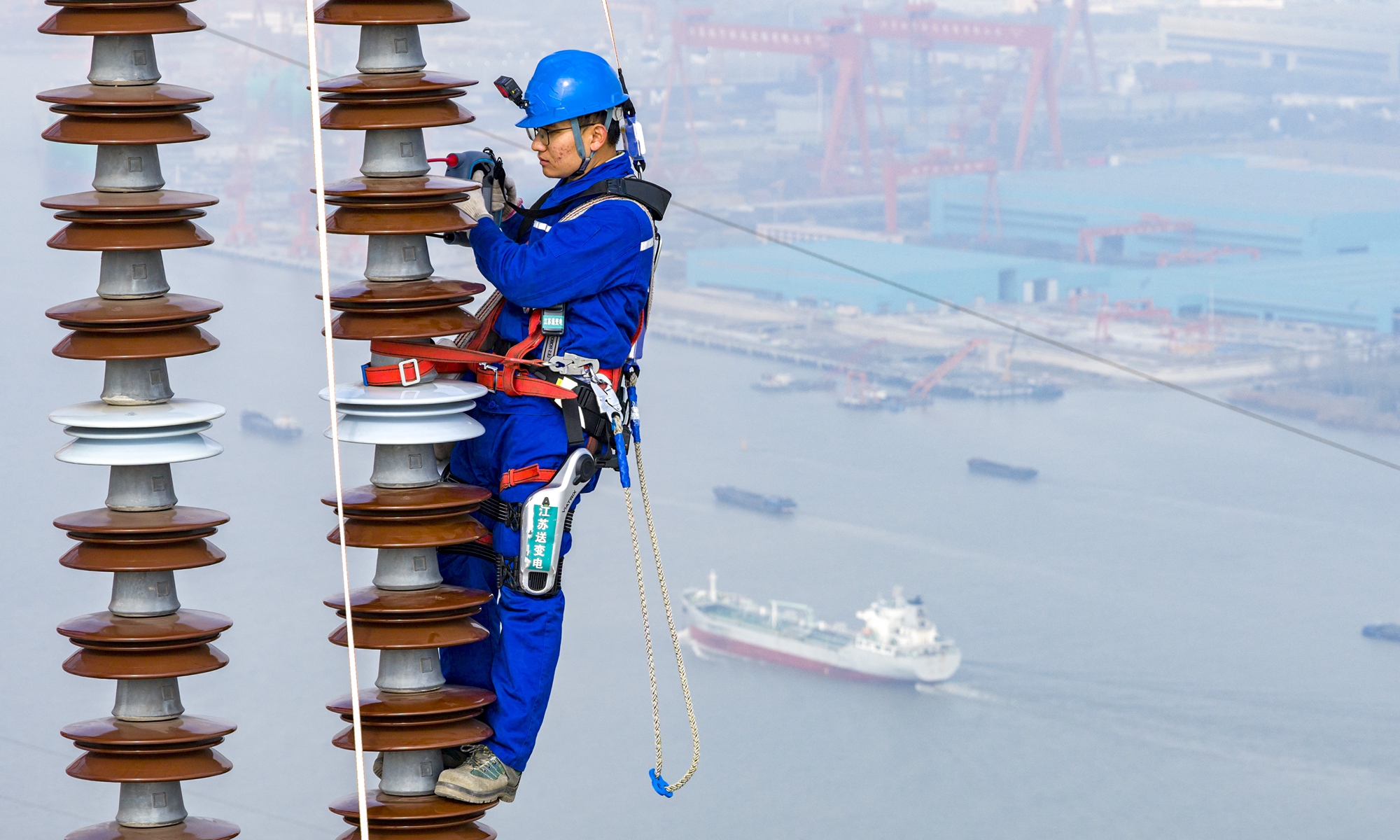
A worker uses exoskeletons to inspect towers of Fengcheng - Meili power transmission line in East China's Jiangsu Province on November 28, 2026. Photo: VCG
Chinese power workers wear exoskeletons to conduct inspection on the towers of Fengcheng-Meili transmission line over the weekend in East China's Jiangsu Province, the CCTV News reported.
Chinese electricity workers on Saturday completed maintenance on the Yangtze River crossing section of the 500 kV Fengcheng-Meili transmission line, running from Taizhou to Wuxi in East China's Jiangsu Province, ahead of the winter peak in power demand across the Yangtze River Delta.
Part of the inspection took place about 370 meters above the river, roughly the height of a 120-story residential building. Workers climbed down vertical insulator strings onto conductors only 35 millimeters in diameter. At that altitude, winds could reach 50 to 74 kilometers per hour, and the conductors swayed constantly as crews edged along them inch by inch, trying to keep their center of gravity low with one hand always gripping the backup safety rope, said Zheng Yimin, head of the inspection service.
The line drops 260 meters in elevation, and the mid-river section sways the hardest — crews must adjust their stance with the conductor's swing and simply wait in place when gusts hit. The full round trip stretches 2,550 meters and takes nearly four hours of line-walking, which is a severe test of physical endurance.
To cut physical strain, exoskeleton robots were used for the first time in this inspection.
The entire suit weighs just 2.5 kilograms — roughly the same as a lightweight laptop. Built-in smart chips use artificial intelligence (AI) to track step frequency and stride length in real time, while dynamically calculating the working conditions.
As workers bend, step and crouch along the conductors, the device provides upward lift and support while stabilizing from below, reducing the strain on their legs in real time. It can cut lower-body muscle load by up to 40 percent at peak, Zheng said.
This maintenance was scheduled before the winter peak to conduct close-range checks on the two towers, the cross-river conductors, fittings and insulators, and to eliminate defects on the spot, ensuring safe and stable operation of this artery, the report cited Zhou Xinyue, deputy director of the Transmission Center at State Grid Wuxi Power Supply Company, as saying.
For ground wires too thin to walk on, autonomous drones flew along the line, closing patrol blind spots.
The Fengcheng-Meili transmission line is China's largest extra-high-voltage cross-river power transmission project, carrying clean energy from northern Jiangsu to the load centers in the south — a key channel for "north-to-south power transfer."
In its three years of operation, the project has delivered more than 53 billion kilowatt-hours, sharply raising the province's cross-river transmission capacity.
RELATED ARTICLES